Follow the Muscles
The natural direction of the quadriceps, calf, and surrounding muscles helps determine the movement of the design.


A leg tattoo can be much more than a design on the thigh or calf. When I work on a larger project, I think about the entire leg — its shape, movement, and how the artwork looks from every angle.
I'm Rinat Tattarin Mingazdinov, a tattoo artist based in Los Angeles. I work across Japanese, realism, biomechanical, bioorganic, color, and black and grey styles, focusing on large-scale projects.
Whether you're planning a full leg sleeve or a substantial piece that could grow into one, I like building the composition around your anatomy from the beginning.
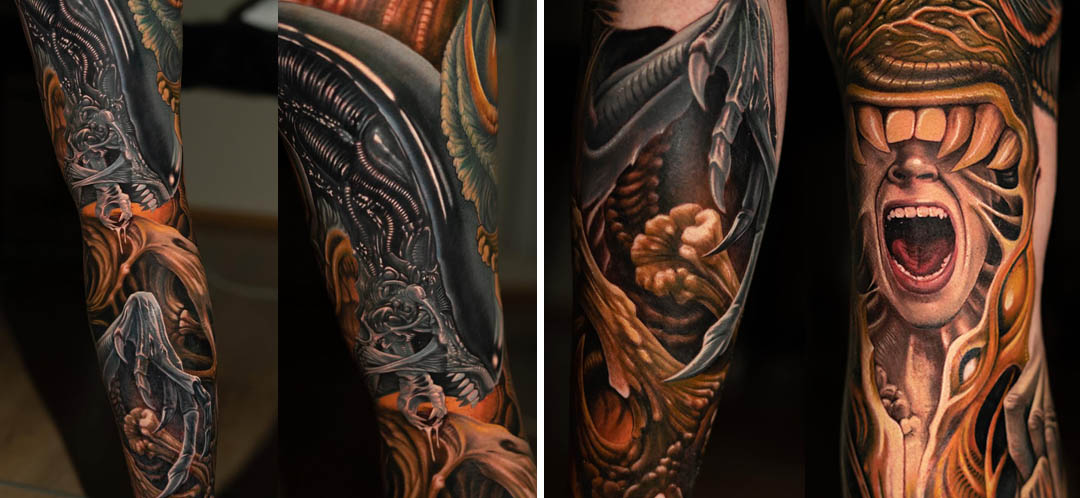
These projects demonstrate how differently a leg tattoo can work depending on the subject, style, and area being covered.
I'm especially interested in compositions that work with the muscles and contours of the leg rather than looking like a flat image placed on the skin.
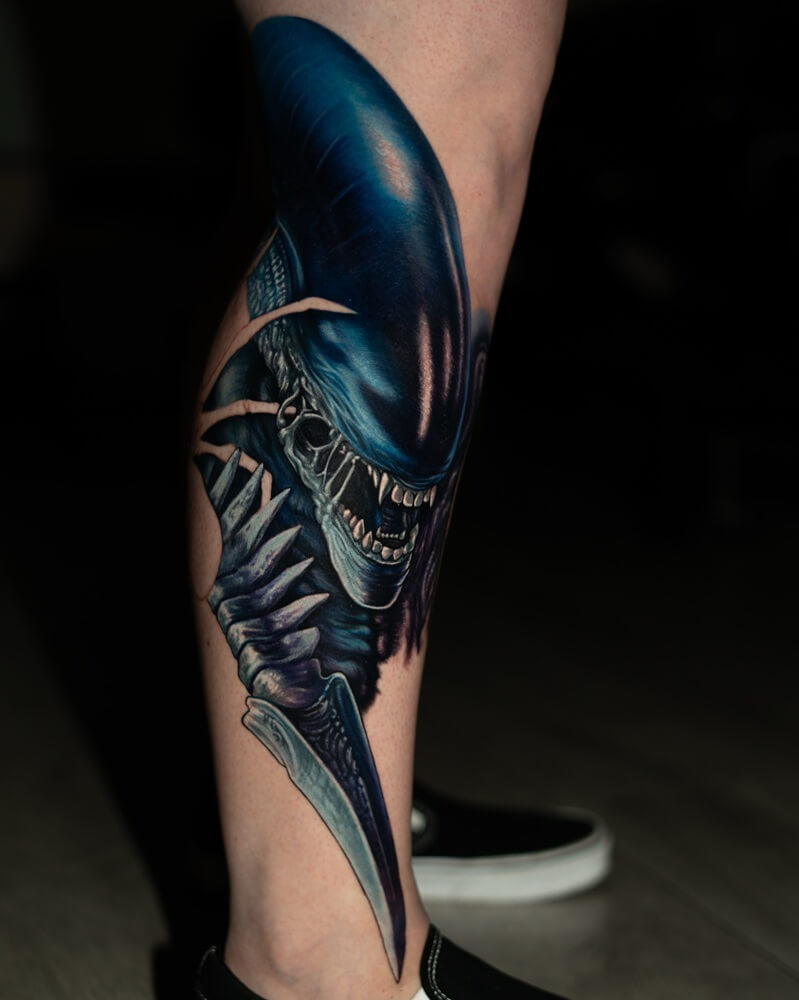
A full leg tattoo should make sense from the front, back, and both sides — not just from the angle used for one photograph.
The thigh, knee, calf, and ankle have different proportions. A design that works on the front of the thigh may need to change direction as it moves toward the side or behind the knee.
I think about which elements should attract attention first, how the transitions should work, and how the overall image follows the leg when you're standing or moving.
For a complete leg sleeve, the goal is to make every section feel connected without losing the clarity of the main subjects.
The natural direction of the quadriceps, calf, and surrounding muscles helps determine the movement of the design.
Backgrounds, secondary elements, and changes in contrast help the composition move naturally around the leg.
Important subjects need enough space to remain recognizable without competing with every detail around them.
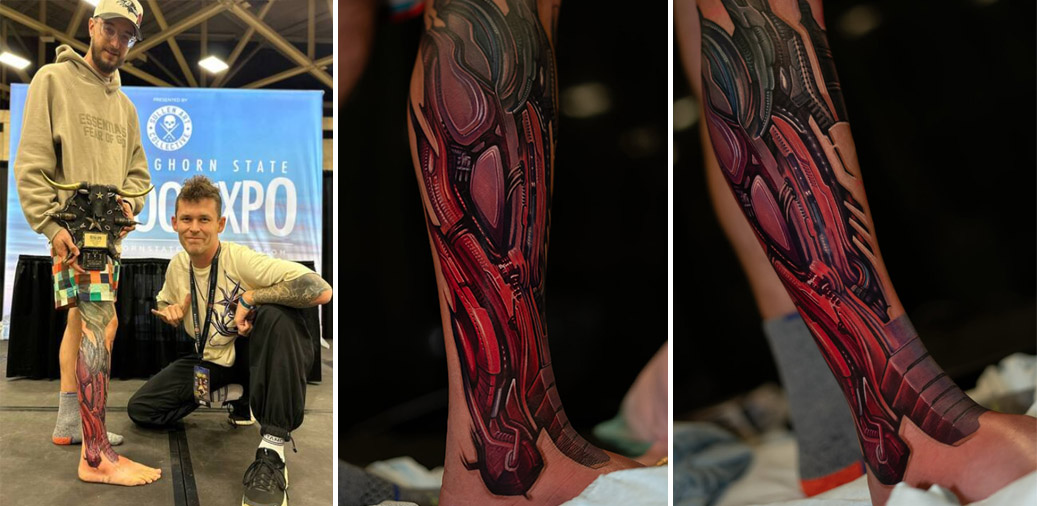
One of my recent leg projects started as a biomechanical tattoo on the thigh. My client and I had already won an award together at a convention in Austin, and we decided to continue the composition down toward the ankle.
At the Longhorn State Tattoo Expo in Dallas, I developed the lower leg over two full working days, connecting the new elements with the existing design.
The challenge was to make the mechanical structures follow the anatomy of the leg, with believable depth, layered forms, and movement.
The finished continuation took first place in the Best Original category. I was particularly happy to see a biomechanical project recognized in a category open to different styles.
For me, this project shows how an existing thigh tattoo can grow into a complete leg composition when the direction and transitions are considered carefully.
Read the Dallas Convention Story ↗The project combines flowing mechanical forms, dark shadows, and red accents. Its structure follows the leg instead of treating the thigh and lower leg as two unrelated surfaces.
It's an example of the kind of large-scale work I enjoy: a design that becomes part of the visual anatomy of the body.
There isn't one correct starting point for every leg tattoo. The size and placement depend on the design, your anatomy, and whether you want the project to expand later.
The thigh provides a broad area for large characters, animals, portraits, or biomechanical forms. It can also become the starting point for a complete leg sleeve.
The calf and shin offer very different surfaces. I consider how a composition should follow their shape and whether the design needs to connect around the sides of the leg.
A full leg sleeve connects the thigh, knee, and lower leg into one composition. It requires planning around the entire circumference rather than building isolated images.
You don't necessarily need to tattoo your entire leg at once. But if there's a chance you'll want a full sleeve later, it's worth thinking about that before choosing where the first design goes.
An isolated tattoo in the middle of the thigh or calf can sometimes make future work more complicated. The existing image may restrict the placement of larger subjects or require an awkward transition.
When we plan ahead, the initial section can look complete on its own while leaving room for future extensions.
That doesn't mean every tattoo has to become a full leg sleeve. I simply prefer giving you the freedom to make that decision later.
The knee creates one of the most interesting challenges in a full leg tattoo. The shape changes when the leg bends, and the front, sides, and back of the joint have different visual characteristics.
I consider the knee early in the planning process, rather than leaving it as an awkward gap between the thigh and calf.
Existing work doesn't automatically prevent a larger project. Depending on its size, position, and style, we may be able to incorporate it, build around it, or consider a cover-up.
Explore Large Tattoo Cover-Ups ↗I work across different tattoo styles and enjoy finding the approach that makes the most sense for a particular idea. A full leg sleeve can be realistic, Japanese-inspired, biomechanical, or a thoughtful combination of influences.
Organic machinery, layered structures, futuristic surfaces, and shapes designed to interact with the muscles of the leg.
Explore Biomechanical Work ↗Dragons, mythological creatures, masks, and flowing backgrounds can create movement around the thigh, knee, and calf.
Explore Japanese Tattoos ↗Realistic subjects, cinematic scenes, detailed shading, and strong contrasts can create large compositions with depth and atmosphere.
Explore Realism Tattoos ↗Large tattoos need more than a good reference image. I want to understand the idea, the size you're considering, and how the design should work with your body.
Send me a description of the subject, preferred style, and placement. If you already have tattoos on the leg, include clear photographs.
We'll discuss the main subjects, their placement, and how the artwork should follow the thigh, knee, and calf. For full sleeves, I consider the complete leg from the beginning.
After agreeing on the direction and booking the project, I generally prepare the design 1–2 weeks before the appointment.
I focus on large tattoos booked in full-day sessions. A full leg sleeve can require multiple appointments depending on its size, style, color, and complexity.
A full leg sleeve is a large tattoo composition covering the leg from the thigh toward the ankle, often wrapping around the front, sides, and back. The main elements and backgrounds are planned to work together as one design.
Yes. A thigh tattoo can be designed as a complete first section while leaving room for a future leg sleeve. It's best to discuss possible extensions before starting so we can plan the composition accordingly.
It depends on the design, amount of coverage, style, and detail. A full leg sleeve is usually a multi-session project. I work in full-day appointments and discuss the expected scope individually.
Yes. The knee requires careful planning because its shape and skin tension change with movement. I consider the position of the joint and how the design will connect the upper and lower leg.
Possibly. It depends on the existing tattoo's placement, size, darkness, and style. Sometimes it can become part of the new design; in other cases, a cover-up or preliminary laser lightening may be worth considering.
Yes. I work with both full-color and black and grey compositions, including biomechanical, Japanese, realistic, and mixed-style projects. The direction depends on your idea and the visual result we're aiming for.
Use my consultation form to send your idea, reference images, and information about the placement. Consultations are free, online or in person in Los Angeles. I usually respond within 1–3 business days. A deposit is required to secure tattoo appointments.
Explore more large-scale tattoos, artistic directions, and projects from my portfolio.
Whether you're planning a full leg sleeve or a substantial thigh or calf project, I'd love to hear your idea. Send me the subjects you're considering, a few references, and some information about the area you want to cover.
We can discuss the composition, placement, and scope during a free consultation. I usually respond within 1–3 business days.