

Every tattoo artist has that one client. The person who walks in with a piece from 1998 that still looks like it was done last month, and next to them, a piece from 2019 that already looks tired. Same skin, same body, sometimes even the same room in the same studio. The difference isn't magic. It's a stack of small decisions — some made at the drawing table, some made in the chair, and most made in the twenty years between the appointment and today.
I've been tattooing since 2002, and one of the quiet privileges of a long career is seeing your own work come back through the door a decade later. It teaches you something no textbook can: how tattoos age in real bodies, in real lives, is far less mysterious than most people think. This guide breaks down what actually happens to ink over time, why some pieces hold and others don't, and what you can do — starting today, whether your tattoo is fresh or twenty years old — to keep it looking sharp.
What Really Happens Under the Skin as Ink Gets Older
Let's start with the biology, because everything else follows from it. When pigment is deposited into the upper dermis, your immune system immediately treats it as a foreign body. Macrophages — the cells that eat debris — swallow individual pigment particles and hold them in place. They don't remove the ink; they just sit there, cell after cell, essentially becoming the tattoo. When one of those macrophages eventually dies, a neighboring cell absorbs the released pigment and takes over. This handoff has been documented in peer-reviewed dermatology research, notably a 2018 study published in the Journal of Experimental Medicine by Baranska and colleagues, which changed how we understand tattoo permanence.
That handoff is imperfect. A small fraction of pigment escapes through the lymphatic system on every cycle, which is why even well-executed work loses a hair of density over the years. On top of that, the dermis itself changes — collagen breaks down, elastin loosens, skin thins, and the canvas you tattooed twenty years ago is no longer geometrically the same canvas. This is the honest story of tattoo aging: it's a slow interaction between three things — the pigment, the skin holding it, and the sun beating down on both.
Why Some Tattoos Fade While Others Barely Move
Ask ten artists why tattoos fade and you'll get ten answers pointing at the same core factors. Here they are, ranked roughly in order of impact:
- UV exposure. By far the biggest cause of tattoo fading. Sunlight breaks down pigment molecules and accelerates skin aging around the ink.
- Depth of pigment placement. Ink placed too shallow sits above the dermal barrier and sheds out early. Placed too deep, it blurs. There's a narrow window — roughly 1 to 2 mm — where it holds cleanly.
- Pigment quality. Reputable manufacturers use stable, well-tested compounds. Cheap or bootleg inks can shift color, break down, or migrate over time.
- Skin type and location. Oily skin, high-friction zones, and areas with constant movement age faster.
- Lifestyle. Smoking, chronic dehydration, and heavy sun tanning all degrade skin quality — and skin quality is the frame around your tattoo.
- Design choices. Fine linework, tiny lettering, and micro-realism carry less pigment volume and show wear faster than bold, solid work.
I want to slow down on that last point, because it's the one clients underestimate the most. A hair-thin line that looks stunning at day one has almost no margin for error. Over twenty years, as skin stretches and shifts, that line will spread — a phenomenon called tattoo fading by some but more accurately called ink migration. Bold work built with real weight ages differently. It softens, but it stays legible.
The Realistic Timeline of How Long Tattoos Last
Let's be direct: how long tattoos last depends on what "last" means. If the question is "will it still be there," the answer is essentially forever, barring surgical removal. If the question is "will it still look like the day I got it," the honest answer is no — but the range between "still gorgeous" and "unrecognizable" is enormous, and most of it is in your hands.
Here's a rough breakdown of what most clients see if they take reasonable care of their skin:
That's the middle-of-the-road version. I've seen twenty-year-old traditional pieces that look nearly identical to the day they healed, and I've seen five-year-old micro-realism go soft because the client was on the beach every weekend without SPF. Genetics, discipline, and the artist's technique stack the deck one way or the other.
The Question Everyone Asks — Do Tattoos Fade
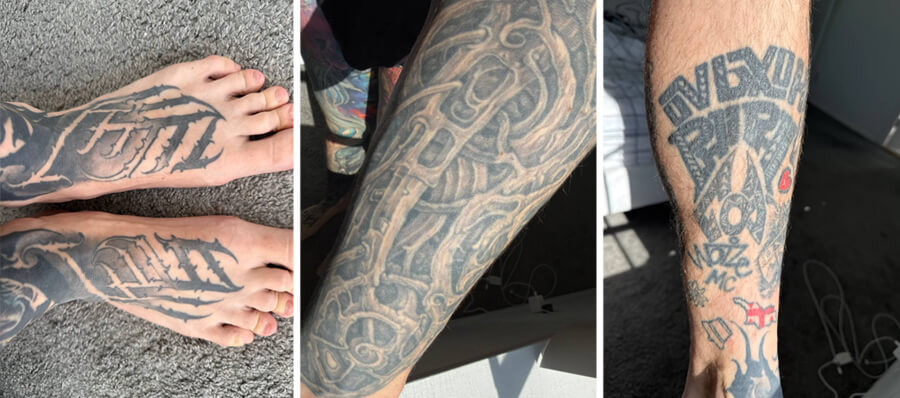
Yes. Every tattoo fades. Do tattoos fade completely to invisibility? Almost never, unless someone deliberately removes them or the piece was done extremely shallow. But even the best-preserved forty-year-old tattoo will show softening compared to how it looked at week six.
The word "fade" gets thrown around loosely, so let me split it into the three things people actually mean:
- Photofading. UV bleaches specific pigment compounds — yellows, reds, and pastels go first. This is direct chemical damage.
- Blur and spread. Ink particles migrate microscopically over decades. Lines widen, small details merge.
- Contrast loss. Aging skin becomes less transparent, so the ink underneath appears less saturated even if no pigment has moved.
Understanding which type of fading you're seeing changes the fix. Photofading responds well to targeted color touch-ups. Blur usually needs a re-line. Contrast loss is largely about the skin around the tattoo — hydration, sun protection, and general skin health.
The Sun — Non-Negotiable, Now and Forever
If I had to reduce the entire conversation about tattoo longevity to a single instruction, it would be this: wear sunscreen on your tattoos, every single day the sun is out, for the rest of your life.
The American Academy of Dermatology recommends broad-spectrum SPF 30 or higher as a daily minimum for sun-exposed skin. For inked skin the case is even stronger, because UV radiation doesn't just age the skin around your tattoo — it breaks down the pigment molecules directly. This is not a fringe claim. Any dermatologist will confirm it, and any old-school tattoo artist has seen the evidence firsthand.
A few practical habits that actually work:
- Apply SPF 30 or higher to any exposed tattoo before going outside — even on overcast days.
- Reapply every two hours when you're actively in the sun.
- Zinc oxide-based sunscreens are especially kind to sensitive skin and give strong UVA/UVB protection.
- Long sleeves and UPF-rated clothing beat sunscreen for full-day outdoor sessions.
- Tanning beds are the worst thing you can do to an aging tattoo. Skip them entirely.
I have clients whose sleeves are pushing thirty years and still read cleanly, and every single one of them has been religious about sun protection. It is genuinely that important. This is how to prevent tattoo fading in the most literal, mechanical sense.
The Habits That Quietly Age a Tattoo Faster Than Anyone Realizes
Beyond sun, a handful of everyday habits shape how a tattoo weathers. Some of these will sound obvious once I list them; most people still ignore them anyway.
Chronic dehydration. Dry skin is thin skin. Thin skin makes pigment look muddy. Drink water. Moisturize daily.
Smoking. Nicotine restricts blood flow to the dermis, slows collagen production, and speeds up skin aging across the board. A smoker's tattoo at forty looks like a non-smoker's tattoo at fifty-five.
Extreme weight fluctuation. Sudden gain or loss stretches the canvas. Tattoos on the stomach, thighs, upper arms, and back are the most affected. Rapid weight loss can leave tattoos with fine stretch lines running through them.
Friction-heavy activities. Rock climbing on your palms, distance running that soaks fabric against a hip tattoo, weightlifting straps across a forearm piece — the constant abrasion over years accelerates surface wear.
Aggressive skincare. Retinoids, glycolic acid, and strong exfoliants over a tattoo will gradually lighten it. If your dermatologist has you on a resurfacing regimen, tell them where your tattoos are and work around them.
Bad first-week aftercare. I know we covered this in the aftercare guide, but it belongs here too — a botched heal produces a tattoo that starts already compromised. Old tattoos that look like they've aged badly often just started badly.
What Old Tattoos Actually Look Like — an Honest Look
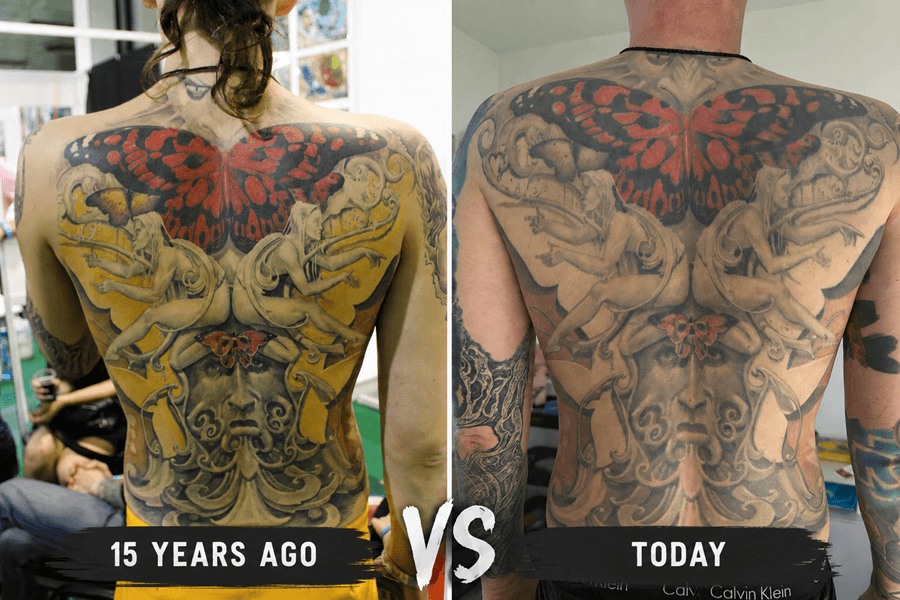
Let's talk about old tattoos without the Instagram filter. A well-aged tattoo has character. Blacks turn to a soft charcoal. Reds mellow to a warmer, brick tone. Fine lines widen by a fraction of a millimeter. What was crisp becomes lived-in, and there's something beautiful about that if you accept it for what it is.
A poorly aged tattoo, by contrast, tends to show one or more of these:
- Colors that have shifted noticeably out of hue (green greens turning blue-gray, blues turning purple)
- Lines that have blurred into shapeless masses
- Patchy density where pigment fell out unevenly
- Halos of migration around the edges of the design
The first list is normal aging. The second list is either bad application, bad aftercare, or extreme sun damage — usually a combination. A tattoo after 10 years should look softer, not sloppier. If yours looks sloppy at ten years, the cause is almost never "the tattoo got old."
How to Prevent Tattoo Fading Over the Long Run
By now the answers should look familiar, but here's the consolidated playbook I give clients who want their pieces to still look strong in twenty years:
- Sunscreen every day. Non-negotiable. This is the single biggest lever for preventing tattoo fading over time.
- Moisturize the tattooed skin daily. Hydrated skin holds color better.
- Choose designs and artists thoughtfully. Bold, well-composed work with proven pigments will always outlast trend-chasing micro pieces.
- Get touch-ups when needed, not when it's too late. A small refresh at year eight is easier than a full rebuild at year twenty.
- Watch your general skin health. What you eat, drink, and smoke shows up on your dermis.
- Cover tattoos during long sun exposure. UPF-rated clothing on beach days makes a real difference.
- Photograph your tattoos annually. It's easier to notice slow changes when you have a record.
None of this is complicated. It's just consistent. Which, honestly, is the recurring theme of everything worth doing well.
When to Consider a Touch-Up on a Tattoo After Years
A tattoo after years of wear sometimes benefits from a light refresh. Here's how I think about it in the studio.
If the piece is bold, well-executed, and cared for, most tattoos don't need touch-ups until year ten or later — sometimes never. If the piece has fine detail, sits on a high-movement zone (hands, feet, elbows, wrists), or has been through significant sun exposure, a light refresh around year five to eight can extend its life significantly.
The rule I use: touch up when the piece still reads clearly but looks softer than you want it. Don't wait until it's unrecognizable — at that point you're re-tattooing, not touching up, and the results are more variable because you're working with scar tissue and shifted skin.
A touch-up is a smaller commitment than the original session. Usually one to two hours, minimal healing time, and the color returns to something close to its original saturation. It's one of the most underused tools in the long game of tattoo longevity.
Wrapping It Up
A tattoo isn't really finished the day it's made. It's finished when you're finished with it — meaning, when you stop being here to look at it. Everything in between is a slow conversation between the ink, your skin, and the choices you make every day. Sun protection, hydration, quality of the original work, and a touch-up when the time is right — that's the whole recipe. There's no secret.
If you're in Los Angeles and you're planning something you want to still look strong in your fifties, sixties, and beyond, the honest answer is that the decisions made before the needle touches skin — style, placement, artist, size — matter as much as anything you do afterward. That's a conversation I'm always happy to have in a consultation. Bring your reference images, your questions, and your timeline. We'll build something that lasts.
FAQ
How long do tattoos last before they need to be redone: Most tattoos never technically need to be redone — the ink stays in the skin for life. In terms of visual freshness, well-cared-for bold work holds strong for fifteen to twenty-plus years before any touch-up becomes worthwhile. Fine linework and delicate color pieces may benefit from a refresh around year five to eight.
Why does my tattoo look faded after only a few years: Usually a combination of sun exposure, dry skin, and — in some cases — pigment being placed a little too shallow. If your tattoo looks noticeably faded within five years, the biggest lever for slowing further wear is daily sunscreen on the area and consistent moisturizing of the surrounding skin.
Do black tattoos age better than color tattoos: Generally, yes. Black pigment is more chemically stable than most colored inks and resists UV degradation better. That said, high-quality color work from a skilled artist, cared for properly, can look excellent for decades. The gap has narrowed considerably as pigment manufacturing has improved.
Can I use anti-aging skincare products over my tattoo: Retinoids, glycolic acid, and other strong exfoliants will gradually lighten a tattoo if applied directly over it. If you're on a resurfacing skincare routine, work around your tattoos or use gentler alternatives on those specific areas. Basic moisturizers and sunscreens are perfectly safe.
Is it worth getting a touch-up on an old tattoo: For most well-executed pieces, yes — especially if the design still reads clearly and you just want to bring back saturation. Touch-ups are shorter, less invasive, and can add another decade of vibrancy to a tattoo you already love. Book one before the piece is severely faded, not after.