
Last spring, a guy came into my studio in West Hollywood with an idea to get a full Japanese sleeve. He showed me several references with dragons and waves, said he was ready to invest time and money, but he had a ton of questions. Where exactly on the arm is best to start? How much does it hurt? How long does it heal? Can I still go to the gym? What do I do with that film they put on after the session?
We spent almost an hour on consultation. I showed him old projects, explained how we'd build the composition, talked about aftercare. Six months later, he had a finished sleeve. Several sessions, each a full day. The result turned out great.
But the most interesting thing was that most of our conversations weren't about the design itself, but about practical matters. How to prepare. Where to place it. How to take care of it. These are the questions that worry people most when they're planning a large project like a Japanese sleeve or back piece.
Let's break it all down step by step.
Where to Place a Japanese Tattoo on Your Body
Japanese style loves space. Small works are possible, but the style reveals itself on large areas. Sleeve, back, thigh, chest. That's where Japanese composition shows itself fully.
Arm: From Wrist to Shoulder
The arm is probably the most popular place for Japanese tattoos. And for good reason. The arm provides good area, natural curves for composition, plus you see your own work every day.
There are several placement options on the arm.
Forearm. A good zone to start. There's enough space for a medium sized design. Many people start right here and then continue up toward the shoulder. The outer side of the forearm is less painful than the inner side. The skin is thicker there, fewer nerves.
Upper arm. Shoulder and bicep are excellent zones. Good area there, muscles create volume, which helps the composition look more dynamic. Plus it's one of the least painful zones on the arm.
Full sleeve. From wrist to shoulder. This is already a serious project, usually several sessions. But it's on a full sleeve that Japanese composition reveals itself maximally. There's room for the main character, background, transitions, details.
By the way, many people ask about positioning. Which way should a forearm tattoo face? Inward or outward? For Japanese style, this isn't as critical. The main thing is that the composition reads when the arm is in a natural position. Usually the main element is placed on the outer side, where it's most visible.
Also, about arm areas for tattoos. The upper part of the arm (shoulder and bicep) is usually less painful than the inner forearm or elbow. If you're doing your first large work, you can start with a more comfortable zone and gradually move forward.
Back: The Ideal Canvas for Large Scale Work
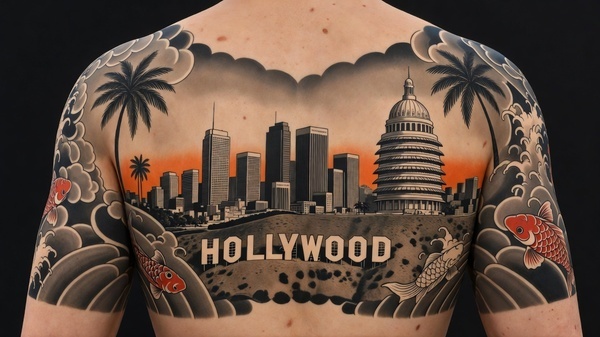
If a sleeve is good, then the back is ideal. The back gives maximum space for complex composition. You can place a large central character there (dragon, tiger, phoenix, samurai), surround it with waves, clouds, flowers, create a real picture.
Traditional Japanese "bodysuits" (full body tattoo coverage) always included the back as the main element. It's the most noticeable and most impressive part of the work.
There's only one downside: you don't see it yourself. But others see it perfectly. And in photos, such works look incredible.
Another point about back and shoulder placement. The upper back, where it transitions to the shoulder, provides an excellent opportunity to start a large project. You can start from there and gradually move down, adding elements. This back tattoo placement allows you to build composition logically and in stages.
Chest and Ribs
Chest and ribs are more painful zones, but they also work great for Japanese style. Often the chest connects with the sleeve, creating a unified composition that flows from shoulder to chest.
Ribs are a difficult place. The skin is thin there, bones are close, it hurts. But if a person is ready, the result is worth it. I won't lie: ribs are one of the most painful zones for tattoos. But many of my clients who went through it say it was worth it.
Thigh and Leg
Thighs and legs are used less often, but they also provide good area for Japanese work. Especially if a full "bodysuit" is planned. Then legs become a logical continuation of the tattoo from back and arms.
The thigh is a fairly comfortable place. There are fewer nerve endings there than on the shin or knee. Plus there's good area for vertical composition. Many women choose the thigh for Japanese works for this exact reason.
Small Japanese Tattoos
Can you get a small Japanese tattoo? Yes. But you need to understand the limitations. If you want a small koi or flower on your wrist, it will be Japanese themed, but not a full Japanese composition.
In such cases, it's better to take one element (for example, a koi carp, small mask, flower) and make it as clean as possible. Without background, without waves, just the object itself. This will look good if the artist understands proportions and can adapt the design to small size.
But if you're initially planning something large scale, it's better to immediately allocate area for a full composition. Then the tattoo will truly reveal itself.
How Much Does a Japanese Tattoo Hurt
Honestly? Yes, it hurts. But it's tolerable.
Pain level depends on the zone. There are places where you sit calmly and can even doze off (seriously, it happens). There are places where every minute is difficult.
Least Painful Zones
Shoulder, upper arm, thigh. There's a good layer of muscle there, thick skin, relatively few nerves. Most people tolerate work in these places without problems. I've seen clients who sat calmly for six to seven hours on the shoulder and barely complained.
Medium Pain Level
Forearm (especially inner side), shin, upper back. Unpleasant, but tolerable. By the end of a long session, the skin gets tired and sensations intensify. But overall these are normal working zones.
Most Painful Places
Ribs, sternum, inner bicep, elbow, knee, wrist, foot. That's where it really hurts. Skin is thin, bones and nerves are close. Every touch of the needle feels sharp.
Ribs are especially difficult. I warn all clients in advance: if you choose ribs, be ready for it to be tough. Many ask for breaks more often. This is completely normal. Quality of work is more important than speed.
What Affects Pain Level
It's not just the zone that matters. There are other factors too.
Your physical condition. If you came hungry, sleep deprived, hungover (please don't do that), pain will feel stronger. Your body is already stressed, and now there's a tattoo on top of it.
Session duration. The first hour is usually tolerable. The second hour is harder. By the fourth or fifth hour, the skin gets tired, and even in a comfortable zone it starts to hurt more. For Japanese works, I do full days, which is usually six to eight hours with breaks. By the end of the day, everyone feels tired.
Your pain threshold. Everyone's is different. Someone sits calmly on ribs. Someone winces even on the shoulder. It's individual. No need to compare yourself to others or be embarrassed if it hurts.
How to Ease Pain During the Session
There are several simple things that really help.
Get sleep before the session. Fatigue amplifies pain perception. If you came after a sleepless night, it will be harder.
Eat normally. Don't come hungry. Blood sugar level affects how you tolerate pain and stress. Bring something sweet with you (chocolate, juice, energy bar). During breaks this helps recovery.
Breathe. Many people involuntarily hold their breath when it hurts. This only makes the situation worse. Breathe deeply and evenly. This really works.
Distract yourself. Listen to music, a podcast, an audiobook. Talk with the artist (if they don't mind). Watch videos on your phone. The less you focus on pain, the easier it is to tolerate the process.
Say if you need a break. Seriously. Nobody expects heroism from you. If you need five minutes to stretch, drink water, breathe, just say so. We'll take a pause. I prefer the client to sit through the session in normal condition rather than endure to the last and then not want to return at all.
Consultation Before a Japanese Tattoo
Any large project starts with consultation. This can be a personal meeting at the studio or an online conversation. The main thing is to discuss the project before you sit in the chair.
What Happens During Consultation
You show references, explain what you like. I ask questions: why this specific image? Do you already have tattoos? Are you planning to expand the project in the future? What's your budget and timeline?
This isn't an interrogation. It's a conversation that helps understand what you want and what's realistically achievable.
Then I explain how we'll build the composition, how many sessions will be needed, what the process will look like. We discuss placement, size, details.
A good consultation takes from half an hour to an hour. If an artist brushes off your questions or says "well okay, come Saturday, we'll figure it out," that's a red flag. Japanese projects require planning.
Can You Do an Online Consultation
Yes. Especially if you're not in Los Angeles or it's inconvenient for you to come to West Hollywood before starting work. We can video call, you show references, we discuss ideas, I explain the process.
Online consultation works well for general planning. But if you have the opportunity to come in person, that's still better. In person it's easier to show old projects, discuss details, look at the studio, meet each other.
Do You Need to Pay for Consultation
Different artists handle this differently. Personally, I don't charge for consultation if someone is actually planning to do a project. It's part of the work. It's important to me that the client and I are on the same wavelength before we start.
But if someone comes just to chat or "look at options" without intention to get tattooed, that's a different story.
What to Ask the Artist
Here are several questions worth asking during consultation:
How many sessions will it take? For a Japanese sleeve, usually three to five full day sessions. For a back, more. It's important to understand the project scale in advance.
How often can I come? Between sessions you need a break for the skin to heal. Usually minimum a month, better six weeks. This means a full sleeve will stretch over six months to a year.
Will you show the sketch in advance? Some artists draw the sketch only on the day of the session. Others are willing to show it a few days ahead. I usually send a rough draft a day or two before so the client can think it over and make changes if needed.
What if touch ups are needed? Sometimes after healing you can see that somewhere color needs to be added or a line adjusted. A good artist includes small touch ups in the project cost.
Can I take breaks during the session? Always. I usually make short pauses every hour and a half to two hours and one long one (for lunch) roughly in the middle of the day.
How Much Does a Japanese Tattoo Cost in Los Angeles
Prices in Los Angeles vary widely. In areas like Beverly Hills or West Hollywood, prices are usually higher than somewhere in the Valley. But it's not just about location, it's also about the artist's level.
How Price is Formed
A Japanese tattoo usually costs the same as other styles of comparable size and complexity. Nobody marks up just because it's "Japanese style."
Price is most often tied to time. Some studios work by the hour (for example, 200 to 300 dollars per hour). Others, like me, prefer full day sessions with a fixed price per day.
A full day session is usually six to eight hours of work with breaks. For Japanese projects, this is the most effective format because it allows you to do a large volume at once while maintaining unity of composition.
Average Cost of a Japanese Sleeve
A full sleeve in Los Angeles usually costs from 3,000 to 8,000 dollars, depending on the artist and complexity of work. This is several sessions stretched over six months or more.
A half sleeve is cheaper, roughly from 1,500 to 4,000 dollars.
Back work is more expensive because there's more area. A full back can cost from 8,000 to 15,000 dollars and up.
Yes, it's expensive. But a good Japanese tattoo is a lifetime investment. Bad work can't be fixed just like that. And quality work from an experienced artist will look great after decades.
Can It Be Done Cheaper
It can. But the question is whether it should be.
If you find an artist who charges 100 dollars an hour instead of 250, ask yourself: why does he charge so little? Maybe he's a beginner building his portfolio. Maybe the quality isn't there. Maybe he works in bad conditions.
Japanese tattoos are complex. They require understanding of composition, clean lines, proper work with color or shading. If the artist doesn't know how to do this, you'll get bad work that you'll later have to cover up or laser off. And that will cost more than going to a good artist right away.
I'm not saying you need to overpay. But in tattoos, as in many other things, price often reflects quality.
Japanese Tattoo Aftercare After the Session
Proper care is critically important. You can get perfect work from the best artist, but if you take care of it wrong, the result will be ruined. Colors will fade unevenly, lines will blur, there may be gaps.
Let's break down the entire healing process step by step.
Right After the Session: Second Skin
After I finish the work, I wash the tattoo, pat it dry, and apply second skin. This is a transparent medical film (called second skin, saniderm, tegaderm different manufacturers have different names, but the essence is the same).
This film protects the fresh tattoo from dirt, bacteria, friction against clothing. Plus under it the skin heals faster and more comfortably.
Fluid will accumulate under the film. This is lymph, a little blood, excess ink. It doesn't look very pretty, but it's absolutely normal. Don't be scared. This is a natural body reaction.
How Long to Keep Second Skin On
The question I get asked after every session: how long to keep second skin on tattoo?
Usually 24 to 48 hours. I recommend removing it after a day or two. Some artists say keep it up to five days, but I prefer a shorter period. After a day or two you can remove it.
If the film started peeling off earlier (for example, after 12 hours), remove it immediately. Don't try to stick it back. If it came off, dirt can get under it, and that's worse than just an open tattoo.
Can You Sleep on a Fresh Tattoo with Second Skin
The first night it's better to avoid direct pressure on the tattoo. But if the film is holding well, you can sleep. The main thing is that the bedding is clean.
If the tattoo is on your back, you'll have to sleep on your stomach or side. If it's on your arm, try not to press it with a pillow. In the first days the skin is sensitive, and extra pressure can be uncomfortable.
When and How to Remove Second Skin
When you remove second skin, do it under warm (not hot) water. This way the film comes off easier and doesn't traumatize the skin. Carefully, without jerking. Pull slowly, parallel to the skin.
If it stuck hard somewhere, hold that spot under the shower longer. Water will soften the adhesive and the film will come off on its own.
After removal, wash the tattoo with warm water and mild soap. I recommend neutral liquid soap without fragrances (baby soap, Cetaphil, something like that). Wash carefully, with your hands, without washcloths.
Then pat dry (don't rub) with a clean paper towel or let it air dry for about five minutes. And apply a thin layer of healing ointment.
What Ointment to Use on Fresh Tattoo
For the first few days it's better to use special healing ointment. I recommend Aquaphor. This isn't pure vaseline, but an ointment with panthenol and other components that help skin recover.
Some people ask: can you use vaseline on tattoo? Technically you can, but I don't advise it. Vaseline (petroleum jelly) creates too dense a film that doesn't let skin breathe. A tattoo under it can heal longer, plus there's risk that pigment will come out unevenly.
Aquaphor is better. It moisturizes, helps healing, but at the same time allows skin to breathe.
Apply ointment in a thin layer. No thick layer needed. The tattoo shouldn't shine from cream. If you applied too much, blot the excess with a paper napkin.
Apply 2 to 3 times a day for the first three to four days.
When to Switch to Regular Lotion
Around the third or fourth day you can switch from healing ointment to regular moisturizing lotion. By this point the tattoo no longer weeps, scabs start forming, skin can tighten and itch.
The lotion should be fragrance free and alcohol free. Lubriderm, Cetaphil, Aveeno. These are classic options that work well.
Apply lotion in a thin layer 2 to 3 times a day or more often if skin is dry. The main thing is don't overdo it. Too much cream is also bad.
How Often to Apply Lotion on Tattoo
Go by feel. If skin is dry, tight, peeling, apply again. If the tattoo is shiny from cream, you overdid it.
Usually 2 to 3 times a day is enough. Morning, afternoon, evening. Some apply more often, especially if the work is on a dry zone (for example, on the shin).
Can You Use Scented Lotion on Healing Tattoo
Better not. Fragrances can irritate skin, especially when it's damaged. Plus many scented lotions contain alcohol, and that's definitely a bad idea for fresh tattoo.
When the tattoo is fully healed (after three to four weeks), you can use any lotion. But in the first weeks stick to neutral options without fragrances.
What to Do If Tattoo Itches
It will itch. This is absolutely normal. Usually itching starts on day 4 to 7, when scabs are actively forming.
Main rule: don't scratch. Never at all. If you pick off scabs, you can damage the pigment. Light spots will remain on the tattoo that will later need to be touched up.
What helps with itching?
Light slapping. Instead of scratching, slap the tattoo with your palm. This relieves itching but doesn't damage scabs.
Cold compress. Clean cloth soaked in cold water. Apply for a few minutes. Cold soothes itching.
Extra layer of lotion. Sometimes it itches because skin is dry. Moisturize again.
Distract yourself. The less you think about it, the easier it is to tolerate.
Itching usually lasts several days. Then it passes. Just be patient.
How Long Does a Japanese Tattoo Take to Heal
Surface healing takes 2 to 3 weeks. During this time scabs come off, skin stops peeling, the tattoo starts looking normal.
But full healing of deep skin layers takes up to two months. That's exactly why between sessions you need a break of at least a month, and better six weeks.
For large Japanese projects I usually make a pause of six to eight weeks between sessions. This gives skin time to fully recover, and gives me opportunity to assess how pigment settled and plan the next stage.
What Not to Do with a Healing Tattoo
Here's a list of things to avoid in the first two to three weeks:
Don't soak the tattoo for long. A quick shower is fine. But don't take a bath, don't go to the pool, don't swim in the sea. Long soaking in water softens scabs, they can fall off prematurely and pull out pigment.
Don't steam the skin. Hot shower, sauna, bath all bad for fresh tattoo. Use warm (not hot) water.
Don't tan. Sun is the enemy of fresh tattoo. UV rays can burn out pigment, cause inflammation, slow healing. If the tattoo is in an open place and you're forced to be in the sun, cover it with clothing.
Don't exercise too actively. Sweat, friction against clothing, skin stretching all this can interfere with healing. Light walks are fine. But heavy workouts, yoga with active stretches, running better postpone for a week or two.
Don't rub the tattoo. When you wash, do it carefully. Without washcloths, scrubs, rough towels. Only with hands and mild soap.
Don't pick scabs. Even if they're falling off and hanging by threads. Let them fall off on their own. If you rip them off, light spots will remain.
Can You Exercise After Getting a Tattoo
Depends on where the tattoo is and what your sport is.
If the tattoo is on your leg and you're doing bench press, no problem. If the tattoo is on your shoulder and you're doing squats, also okay.
But if the tattoo is on your shoulder and you want to do presses or pull ups, that's a bad idea. Movement stretches skin, clothing rubs, you sweat. All this interferes with healing.
I recommend taking a break from workouts for at least a week after a large session. Then you can gradually return, but avoid exercises that directly engage the zone with the tattoo for another week or two.
Yes, it's inconvenient. But it's better to take a break for a couple weeks than to ruin work that you and the artist spent a whole day on.
Does the Studio Accept Walk-Ins for Japanese Tattoos
This question gets asked often, especially by people looking for a tattoo studio in Los Angeles for the first time.
A walk in is when you come without an appointment and ask to get tattooed right away. Many tattoo shops in LA, especially on Melrose or in Hollywood, accept walk ins. It's convenient for small, simple works.
But for Japanese tattoos, walk in is usually a bad idea.
Why Japanese Work Isn't Suitable for Walk-In
Japanese tattoo requires planning. You need to think through composition, prepare a sketch, understand how the design will lay on your body. This is impossible to do an hour before the session.
Plus Japanese works are usually large. Even a small element takes several hours. And a full sleeve or back piece is several full day sessions.
If you come walk in and say "I want a Japanese dragon on my shoulder," at best they'll schedule you a consultation for another day. At worst they'll offer something quick and simple that has nothing to do with real Japanese style.
When Walk-In Can Work
If you want something small in Japanese theme (small flower, simple symbol, one element without background), some studios can do this as walk in. But it will be exactly a small work, not a full Japanese composition.
Personally, I don't do walk ins for Japanese projects. I work by appointment, with consultation, with sketch preparation. It's the only way to guarantee quality.
How to Choose the Right Body Placement for a Specific Design
One of the important points we discuss during consultation is matching design and placement.
Not every design suits every place. Vertical composition (for example, koi swimming up) logically looks good on arm or leg. Horizontal (for example, dragon stretched lengthwise) will lay better on back or around thigh.
Designs for Sleeve
For a sleeve, vertical or spiral compositions work well. The main character is placed on the outer side of the arm (where it's most visible), background and additional elements wrap around.
Classic example: dragon or koi on outer side, waves or flowers on inner side.
Designs for Back
The back allows you to create a picture with a clear center. Usually the main character (dragon, tiger, phoenix, mask) is placed in the center, between shoulder blades or slightly lower. Background (waves, clouds, flowers) spreads to the sides, filling the entire area.
The back is also good for symmetrical compositions or, conversely, for dynamic ones where action unfolds from one side to another.
Designs for Chest
Chest often combines with shoulder and sleeve. Composition starts on shoulder, flows to chest, and can even descend to ribs.
For chest, wide, spread out elements work well (phoenix wings, spreading branches, waves).
Considering Anatomy
A good artist always considers anatomy. Muscles, body curves, natural lines. Japanese composition should follow the body, not conflict with it.
For example, waves can repeat the curve of the bicep. A dragon's tail can wrap around the arm, following its shape. Flowers can fill space between main elements, smoothing transitions.
This is one reason why I prefer to draw part of the design freehand, directly on the body. That way lines lay more naturally.
Final Thoughts
A Japanese tattoo is a project. Not a quick Friday evening decision. It requires time, money, patience, planning. But if you're ready to invest, the result is worth it.
I've seen people start with one session on the forearm and a year later come to finish a full sleeve. Seen someone do work on the shoulder and then decide to continue onto the back. It's a natural process. Japanese style pulls you in.
If you're in Los Angeles or planning to visit, and you're thinking about a Japanese tattoo, come in for a consultation. We can discuss your ideas, I'll show work examples, explain the process. I work at Inkology Tattoo Art Gallery in West Hollywood, not far from Beverly Hills and Santa Monica. Easy to reach from any part of the city.
Japanese style is something I've worked with for many years, and I'm always happy to help people create something truly quality and meaningful.
Japanese tattoos: meaning, sketches, and characteristics of Japanese-style tattoos
View the artist's work in the Japanese tattoo style