Why Realism Has a “Difficult” Style
Journalist: A lot of people say realism is the most difficult tattoo style. Do you, as a tattoo artist, agree with this?
Rinat: It really depends on who we are talking about. For someone who can draw, understands anatomy, light, and shadow, and has at least a basic academic art background, realistic tattooing does not feel like some unreachable peak. For someone who just bought a machine, never studied drawing, and wants to jump straight into realistic portraits, it very quickly turns into a serious challenge.
The idea that realism is “the hardest style” grew out of a time when many people came into tattooing more for the industry than for the art. A lot of them worked in traditional styles with bold outlines, limited palettes, and simple shapes, without heavy technical demands. Then someone did a truly realistic portrait, and artists who were used to simple flash saw it and realized, “Okay, this is a different level.”
Today the scene looks different. Many tattooers come into the industry with a background in drawing, illustration, or design, so realistic tattoo designs feel much more natural to them. Realism by itself is not automatically the hardest style, it is mainly difficult for those who do not have any drawing foundation.
Rinat: It really depends on who we are talking about. For someone who can draw, understands anatomy, light, and shadow, and has at least a basic academic art background, realistic tattooing does not feel like some unreachable peak. For someone who just bought a machine, never studied drawing, and wants to jump straight into realistic portraits, it very quickly turns into a serious challenge.
The idea that realism is “the hardest style” grew out of a time when many people came into tattooing more for the industry than for the art. A lot of them worked in traditional styles with bold outlines, limited palettes, and simple shapes, without heavy technical demands. Then someone did a truly realistic portrait, and artists who were used to simple flash saw it and realized, “Okay, this is a different level.”
Today the scene looks different. Many tattooers come into the industry with a background in drawing, illustration, or design, so realistic tattoo designs feel much more natural to them. Realism by itself is not automatically the hardest style, it is mainly difficult for those who do not have any drawing foundation.
Why Portrait Tattoos Are So Demanding
Journalist: Portrait tattoos have a special reputation. Why are tattoo portraits considered so difficult?
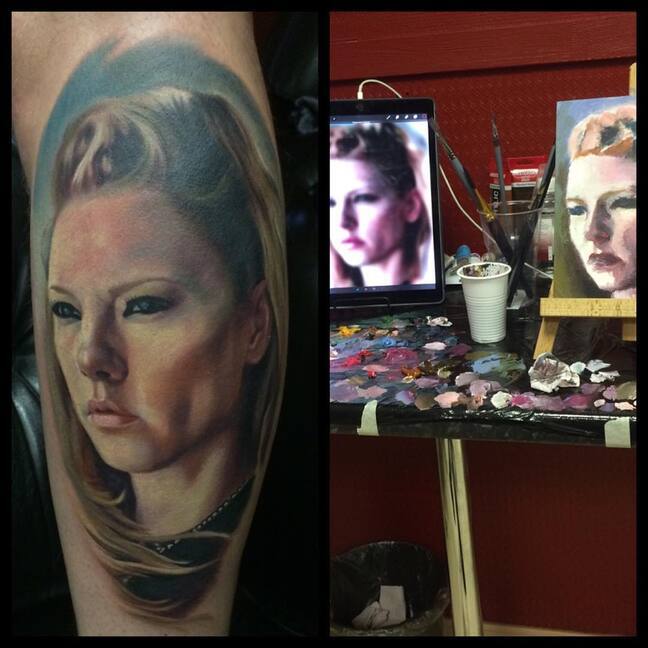
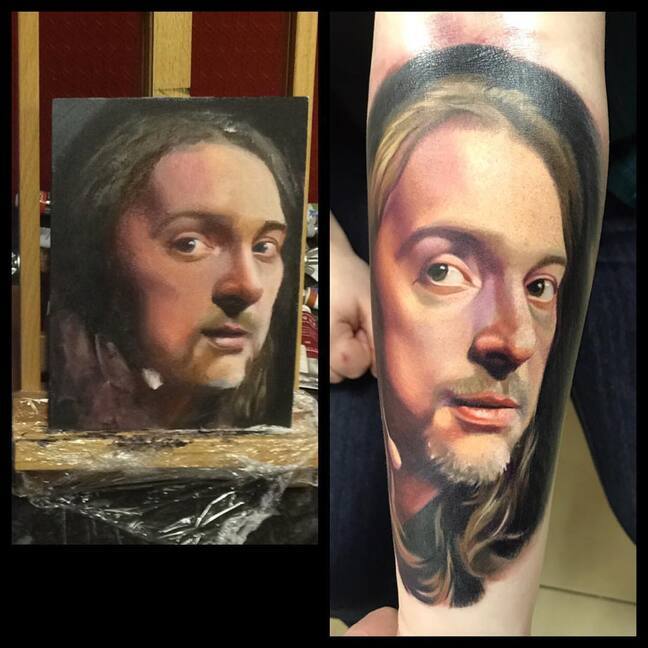
Rinat: A portrait tattoo does not forgive mistakes. You are not just creating a nice face, you are capturing a specific person. If the proportions are off even slightly, most people will not see the exact technical error, but they will instantly feel that something is wrong.
Portraits are hard for beginners and for tattoo artists who came from other styles and never seriously practiced drawing faces. They lack repetition, they do not know what to focus on, how to build the skull underneath, where to push contrast, how to maintain likeness. Without that knowledge, a realistic portrait tattoo becomes guesswork.
When artists with a strong academic background enter tattooing, they adapt to realism much faster. Many well known realism artists spent years drawing portraits before they ever touched a tattoo machine. First they learned to build a face on paper, then they brought that skill onto skin. That gives a completely different level of confidence once you sit down for a portrait session. There are talented self taught artists as well, but those are exceptions, not the system. In reality, if someone wants to become strong in portrait realism, they still need academic drawing, anatomy, color theory, and a lot of practice.
Rinat: A portrait tattoo does not forgive mistakes. You are not just creating a nice face, you are capturing a specific person. If the proportions are off even slightly, most people will not see the exact technical error, but they will instantly feel that something is wrong.
Portraits are hard for beginners and for tattoo artists who came from other styles and never seriously practiced drawing faces. They lack repetition, they do not know what to focus on, how to build the skull underneath, where to push contrast, how to maintain likeness. Without that knowledge, a realistic portrait tattoo becomes guesswork.
When artists with a strong academic background enter tattooing, they adapt to realism much faster. Many well known realism artists spent years drawing portraits before they ever touched a tattoo machine. First they learned to build a face on paper, then they brought that skill onto skin. That gives a completely different level of confidence once you sit down for a portrait session. There are talented self taught artists as well, but those are exceptions, not the system. In reality, if someone wants to become strong in portrait realism, they still need academic drawing, anatomy, color theory, and a lot of practice.
References for Portrait Realism
Journalist: What does a good portrait tattoo design start with?
Rinat: Always with a good photo.
When we talk about realistic portrait tattoos, the reference is the foundation. These days it is not hard to set up a short studio shoot. If someone wants a realistic portrait of a beloved pet, you can bring the animal to the studio or invite a photographer to your home to get high contrast, sharp images without blown out highlights.
You tell the photographer you are planning a realistic tattoo, that you need strong contrast, clean light, and proper separation of light and shadow, without areas on skin or fur burned to pure white. A well shot portrait, whether of a person or an animal, gives the tattoo artist all the information needed to build volume and detail.
If the original photo is flat, blurry, or killed by filters, there is no magic trick that will turn it into an ideal tattoo design. A realistic tattoo stands on a quality reference, and there is no shortcut around that.
Rinat: Always with a good photo.
When we talk about realistic portrait tattoos, the reference is the foundation. These days it is not hard to set up a short studio shoot. If someone wants a realistic portrait of a beloved pet, you can bring the animal to the studio or invite a photographer to your home to get high contrast, sharp images without blown out highlights.
You tell the photographer you are planning a realistic tattoo, that you need strong contrast, clean light, and proper separation of light and shadow, without areas on skin or fur burned to pure white. A well shot portrait, whether of a person or an animal, gives the tattoo artist all the information needed to build volume and detail.
If the original photo is flat, blurry, or killed by filters, there is no magic trick that will turn it into an ideal tattoo design. A realistic tattoo stands on a quality reference, and there is no shortcut around that.
Color Realism vs Black and Gray
Journalist: What is better, color realism or black and gray realism?
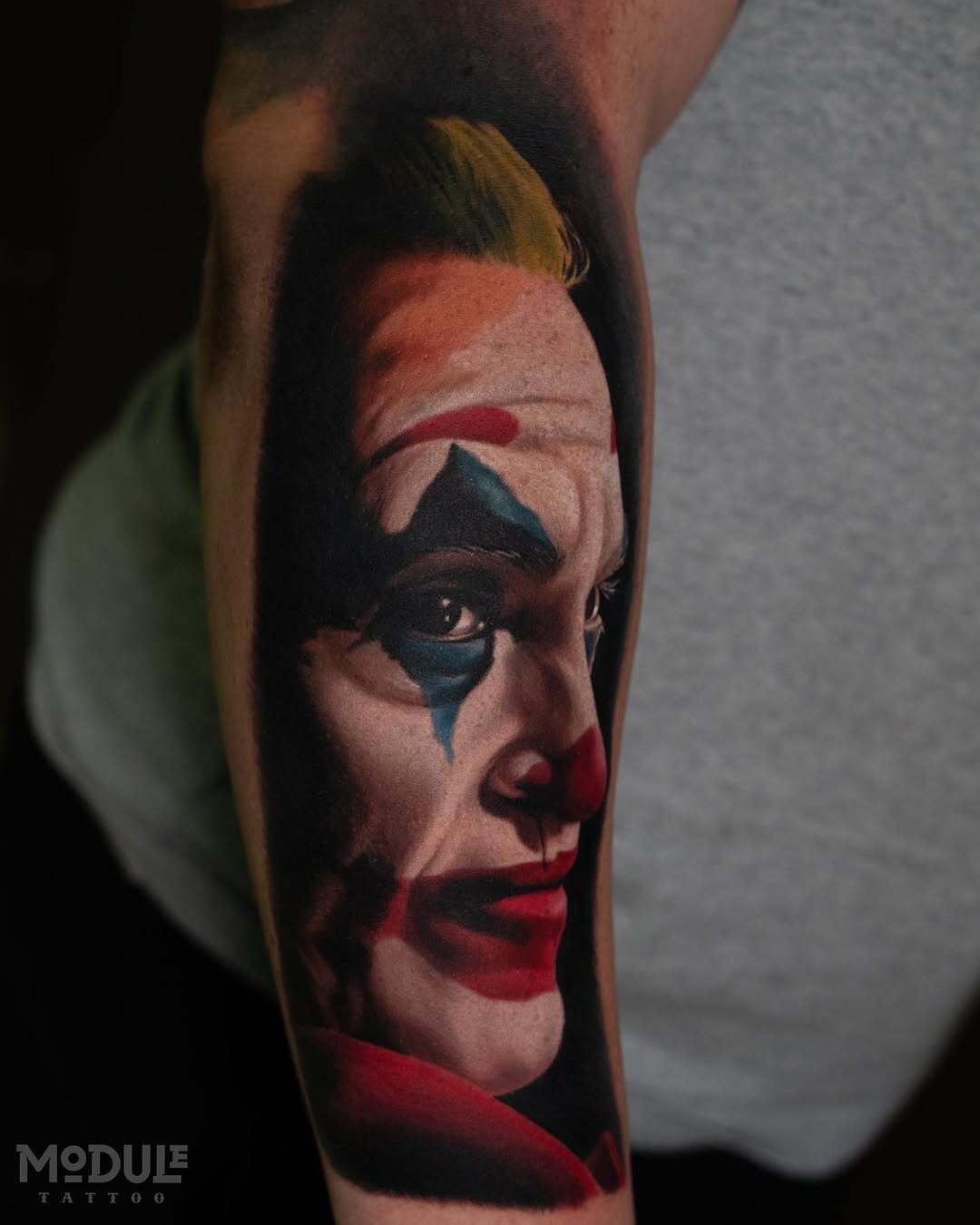
Rinat: That argument will never end. Some people love bright color tattoo designs, others prefer classic black and gray realism. There is no universal right answer.
Right now, I often lean toward black and gray. It usually holds up better in real life. Color realistic tattoos can look amazing for the first years, but they react more to the sun, especially in places where there is a lot of sunlight and you cannot avoid it in daily life. If someone actively uses SPF, keeps reapplying it, and covers their tattoos from direct sun at the beach and festivals, they can keep the color bright for a long time.
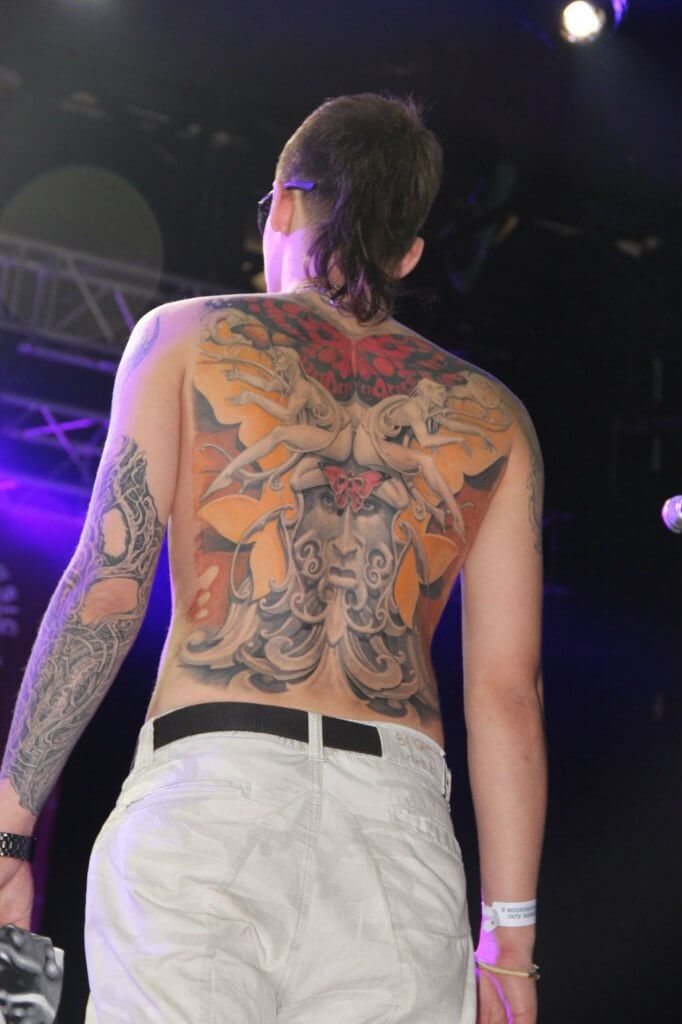
In reality, people forget sunscreen, spend a lot of time outdoors, and travel to sunny places. In my case, long stays in a hot climate noticeably washed out yellow, skin tone, brown, and orange pigments on my back tattoos. Black and gray behaves differently, even with strong sun exposure the tattoo stays readable and does not fall apart visually.
If a person wants a realistic tattoo that will stay clear and expressive for many years with moderate care, black and gray realism is often the more reliable option. Color works great when the client understands the trade off and is willing to maintain it.
Rinat: That argument will never end. Some people love bright color tattoo designs, others prefer classic black and gray realism. There is no universal right answer.
Right now, I often lean toward black and gray. It usually holds up better in real life. Color realistic tattoos can look amazing for the first years, but they react more to the sun, especially in places where there is a lot of sunlight and you cannot avoid it in daily life. If someone actively uses SPF, keeps reapplying it, and covers their tattoos from direct sun at the beach and festivals, they can keep the color bright for a long time.
In reality, people forget sunscreen, spend a lot of time outdoors, and travel to sunny places. In my case, long stays in a hot climate noticeably washed out yellow, skin tone, brown, and orange pigments on my back tattoos. Black and gray behaves differently, even with strong sun exposure the tattoo stays readable and does not fall apart visually.
If a person wants a realistic tattoo that will stay clear and expressive for many years with moderate care, black and gray realism is often the more reliable option. Color works great when the client understands the trade off and is willing to maintain it.
Placement of Realistic Tattoos on the Body
Journalist: Where on the body do realistic tattoos look best, and how does placement affect the outcome?
Rinat: Placement is half of the result. You always have to think about how that part of the body moves.
If you put a realistic portrait right on the kneecap, the face will distort every time the leg bends, and the changes will not look subtle, they will look bad. The same portrait placed higher on the thigh behaves much more stable. The thigh is a great canvas for realistic tattoo designs, there is enough space and volume and fewer harsh deformations.
The general rule is simple, key elements like faces, animals, and main characters work best on flatter and less mobile areas. Joints and highly mobile zones, such as knees and elbows, are better for background, transitions, textures, and secondary details. If someone wants a Spider Man sleeve, it makes sense to put Spider Man himself on the outer or upper arm and move the logo, city, or abstract background into the elbow and inner arm areas.
Realism is not only about people. If someone wants a realistic oil rig, placing it near the elbow can create a fun effect where bending the arm makes it look like the rig is pumping. Distortion can be a problem or part of the concept, depending on how consciously you design the piece.
The ideal scenario is to develop the tattoo concept first and then choose the best body placement for it, not the other way around. In real life it is often messier, many clients already have multiple tattoos and you have to work with the remaining open spaces, a small spot below the knee, a narrow strip on the side, and so on. But if you are planning a large realistic piece from scratch, thinking about placement early gives you a huge advantage.
Rinat: Placement is half of the result. You always have to think about how that part of the body moves.
If you put a realistic portrait right on the kneecap, the face will distort every time the leg bends, and the changes will not look subtle, they will look bad. The same portrait placed higher on the thigh behaves much more stable. The thigh is a great canvas for realistic tattoo designs, there is enough space and volume and fewer harsh deformations.
The general rule is simple, key elements like faces, animals, and main characters work best on flatter and less mobile areas. Joints and highly mobile zones, such as knees and elbows, are better for background, transitions, textures, and secondary details. If someone wants a Spider Man sleeve, it makes sense to put Spider Man himself on the outer or upper arm and move the logo, city, or abstract background into the elbow and inner arm areas.
Realism is not only about people. If someone wants a realistic oil rig, placing it near the elbow can create a fun effect where bending the arm makes it look like the rig is pumping. Distortion can be a problem or part of the concept, depending on how consciously you design the piece.
The ideal scenario is to develop the tattoo concept first and then choose the best body placement for it, not the other way around. In real life it is often messier, many clients already have multiple tattoos and you have to work with the remaining open spaces, a small spot below the knee, a narrow strip on the side, and so on. But if you are planning a large realistic piece from scratch, thinking about placement early gives you a huge advantage.
How Many Motifs in a Sleeve or Back Piece
Journalist: If a client wants a realistic sleeve, how many main images make sense on one arm?
Rinat: There is no rigid rule, but there is common sense.
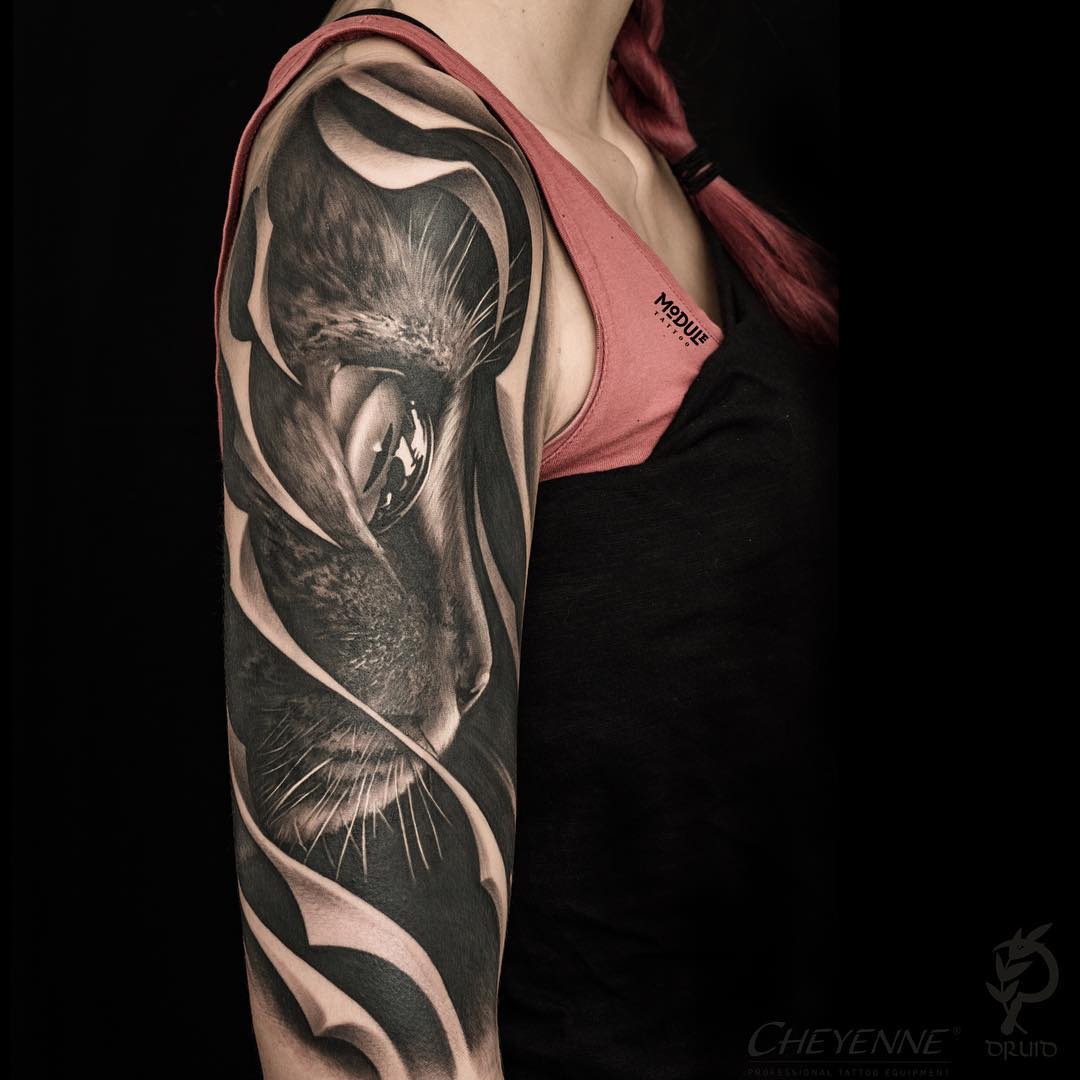
You can roughly divide the arm into four relatively stable zones that do not distort too much as the arm moves. In a solid realistic sleeve you usually see between one and four main objects. One big character over the whole arm can look very powerful. Two or three key motifs also work well, for example two portraits and one large symbolic element. Once you go beyond four main objects, especially in realism, they start to compete with each other and the sleeve turns into visual noise.
The rest of the sleeve can be filled with secondary details, textures, and background that tie everything into a single composition, but the viewer’s eye still needs to clearly read the main elements from a distance. That is the difference between an expensive, well planned sleeve tattoo and a random collage.
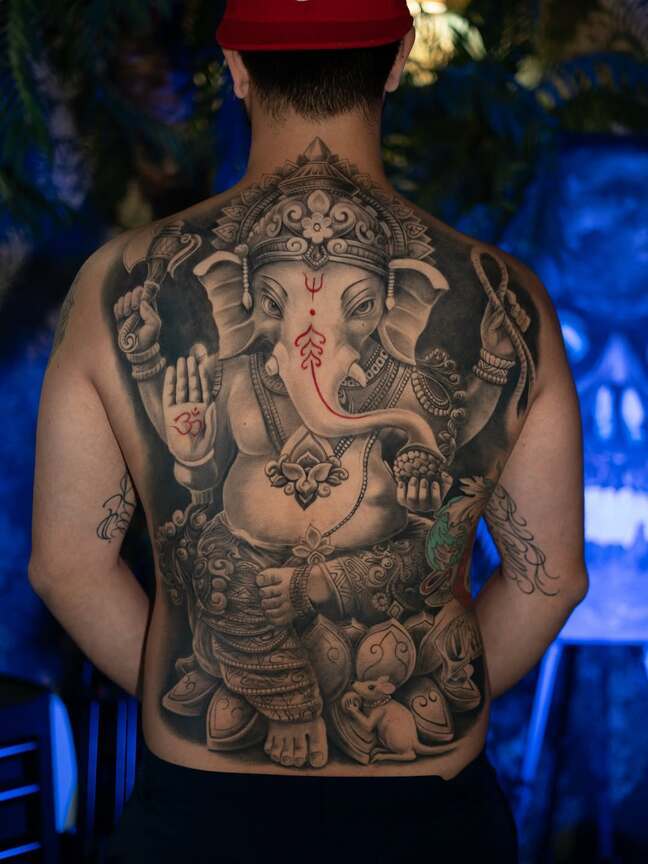
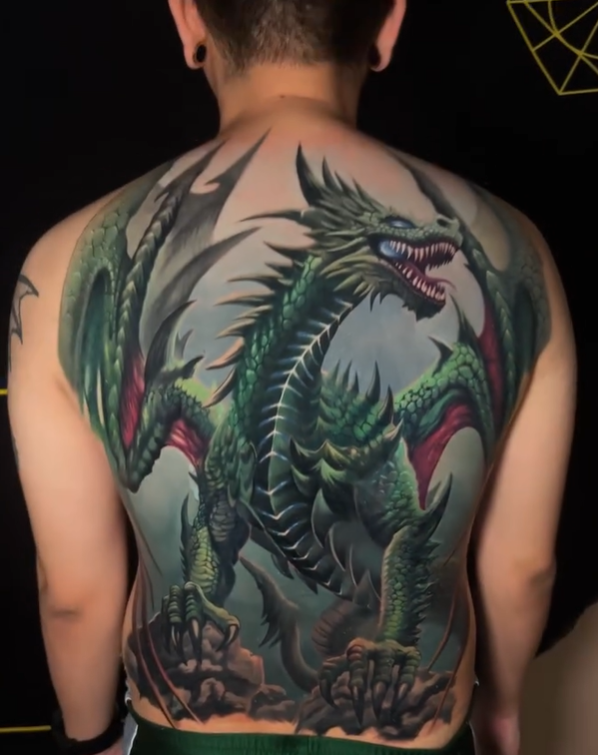
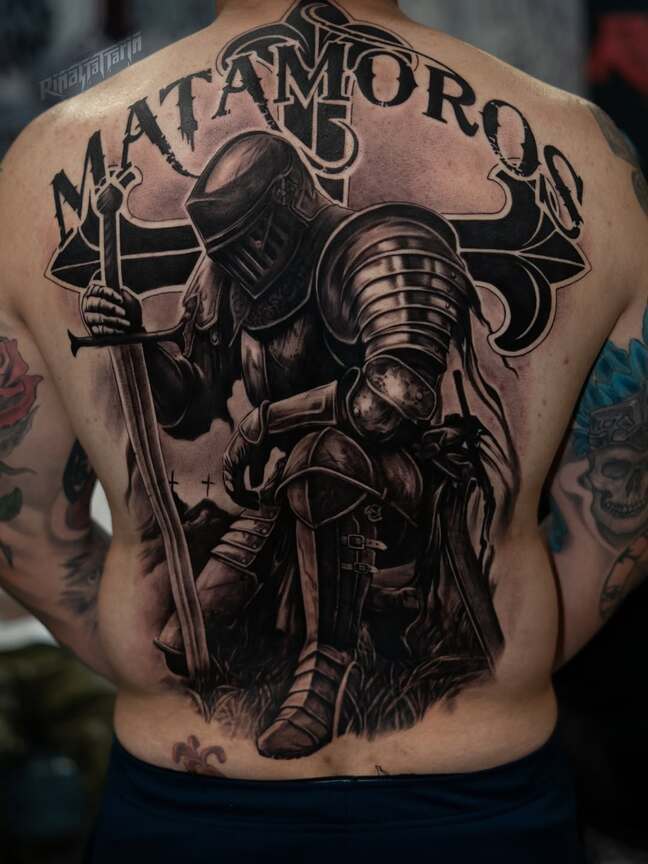
I am even stricter with the back, one main object is almost ideal. The back is the largest and most readable surface. If you try to pack in, say, six realistic lions, a male, a female, and four cubs, from a distance it will all blend into one big patch. One large, well composed lion will read much better, the details will not get lost, and the piece will stay impressive for years. That is how you get a strong back piece instead of just filled skin.
Rinat: There is no rigid rule, but there is common sense.
You can roughly divide the arm into four relatively stable zones that do not distort too much as the arm moves. In a solid realistic sleeve you usually see between one and four main objects. One big character over the whole arm can look very powerful. Two or three key motifs also work well, for example two portraits and one large symbolic element. Once you go beyond four main objects, especially in realism, they start to compete with each other and the sleeve turns into visual noise.
The rest of the sleeve can be filled with secondary details, textures, and background that tie everything into a single composition, but the viewer’s eye still needs to clearly read the main elements from a distance. That is the difference between an expensive, well planned sleeve tattoo and a random collage.
I am even stricter with the back, one main object is almost ideal. The back is the largest and most readable surface. If you try to pack in, say, six realistic lions, a male, a female, and four cubs, from a distance it will all blend into one big patch. One large, well composed lion will read much better, the details will not get lost, and the piece will stay impressive for years. That is how you get a strong back piece instead of just filled skin.
How to Look for a Realism Artist
Journalist: Many people type things like “realistic tattoo artist near me” or “tattoo shops near me” into search. How should they really look for a top artist in realism?
Rinat: The “near me” filter is great for coffee, not for a tattoo you will wear for the rest of your life.
If you type “realistic tattoo artist near me” and stop there, you risk limiting yourself to studios within a couple of miles, even if none of them are really strong in realism. Sometimes the right artist for your idea works in another part of town, another city, or even another country. For a serious session that will stay with you forever, it makes sense to widen your search radius.
A smarter approach looks like this, scroll through Instagram, TikTok, and specialized platforms to find realism artists whose work genuinely resonates with you, search not only by “tattoo shop” in a specific city, but also with queries like “realistic tattoo artist,” “portrait tattoo,” “black and gray realism,” “realistic sleeve tattoo,” “cover up tattoo in realism.” Always look at healed photos, not just fresh ones.
A couple of evenings of this kind of research dramatically increase your chances of getting a tattoo you will still love in twenty years, rather than a compromise piece just because the studio happened to be close to your home.
Rinat: The “near me” filter is great for coffee, not for a tattoo you will wear for the rest of your life.
If you type “realistic tattoo artist near me” and stop there, you risk limiting yourself to studios within a couple of miles, even if none of them are really strong in realism. Sometimes the right artist for your idea works in another part of town, another city, or even another country. For a serious session that will stay with you forever, it makes sense to widen your search radius.
A smarter approach looks like this, scroll through Instagram, TikTok, and specialized platforms to find realism artists whose work genuinely resonates with you, search not only by “tattoo shop” in a specific city, but also with queries like “realistic tattoo artist,” “portrait tattoo,” “black and gray realism,” “realistic sleeve tattoo,” “cover up tattoo in realism.” Always look at healed photos, not just fresh ones.
A couple of evenings of this kind of research dramatically increase your chances of getting a tattoo you will still love in twenty years, rather than a compromise piece just because the studio happened to be close to your home.
Wait Times and Booking a Session
Journalist: How long does someone usually have to wait to get an appointment with a good realism artist?
Rinat: It depends on the artist’s schedule and on the complexity of the project, but you should not count on getting a full day session next week.
For in demand tattoo artists who work well in realism, a normal wait time is from one to two months. During that period you can discuss the design, choose the placement, approve references, and figure out how many sessions you will need. If you are aiming for a large piece, a realistic sleeve, a back piece, or a serious cover up tattoo, you need to think in weeks and months, not days.
Rinat: It depends on the artist’s schedule and on the complexity of the project, but you should not count on getting a full day session next week.
For in demand tattoo artists who work well in realism, a normal wait time is from one to two months. During that period you can discuss the design, choose the placement, approve references, and figure out how many sessions you will need. If you are aiming for a large piece, a realistic sleeve, a back piece, or a serious cover up tattoo, you need to think in weeks and months, not days.
How Pricing Works in Realism
Journalist: Do prices for realistic tattoos differ from other styles?
Rinat: In most professional studios, the style itself does not change the basic pricing model.
Tattoo prices are usually based on either a full day rate or an hourly rate. A full day in the chair often means six to eight hours of work, depending on the artist and studio policy. Some tattoo artists prefer hourly pricing for smaller pieces. Others give a fixed price for the whole project, they estimate how long a realistic tattoo will take and commit to finishing it in one or several sessions.
Realism, traditional, cover up, the cost is usually tied to time, skill level, and demand, not just to the style label. Realistic tattoos typically take longer because of the level of detail and prep work, so a portrait tattoo or a realistic sleeve will often fall into a higher budget range than a small, simple design.
Rinat: In most professional studios, the style itself does not change the basic pricing model.
Tattoo prices are usually based on either a full day rate or an hourly rate. A full day in the chair often means six to eight hours of work, depending on the artist and studio policy. Some tattoo artists prefer hourly pricing for smaller pieces. Others give a fixed price for the whole project, they estimate how long a realistic tattoo will take and commit to finishing it in one or several sessions.
Realism, traditional, cover up, the cost is usually tied to time, skill level, and demand, not just to the style label. Realistic tattoos typically take longer because of the level of detail and prep work, so a portrait tattoo or a realistic sleeve will often fall into a higher budget range than a small, simple design.
Is Realism Really “Top Tier”
Journalist: In the tattoo community people often say realism is the highest level of skill. Do you see realistic tattoos as the peak of mastery?
Rinat: No, I would not call it that.
Realism is impressive, and to many clients it looks like the most advanced style because it is close to photography. But from an artistic point of view, some more illustrative or conceptual approaches can be even more complex. There you are not copying reality, you are building a new visual world from scratch. That demands composition, imagination, and a different kind of thinking.
Today, for a professional tattoo artist, realism is more of a base. It is a strong technical foundation, you learn to understand volume, light, anatomy, and texture. Once you have that, the real high level starts later, in how you turn that skill into something unique with your own language and ideas. Realism by itself is not the final stop, it is the starting point. That is where truly original work begins.
Rinat: No, I would not call it that.
Realism is impressive, and to many clients it looks like the most advanced style because it is close to photography. But from an artistic point of view, some more illustrative or conceptual approaches can be even more complex. There you are not copying reality, you are building a new visual world from scratch. That demands composition, imagination, and a different kind of thinking.
Today, for a professional tattoo artist, realism is more of a base. It is a strong technical foundation, you learn to understand volume, light, anatomy, and texture. Once you have that, the real high level starts later, in how you turn that skill into something unique with your own language and ideas. Realism by itself is not the final stop, it is the starting point. That is where truly original work begins.
Repeated Motifs and Real Life Practice
Journalist: Is there anything that especially annoys you or, on the contrary, pleases you in the world of realistic tattoos?
Rinat: There is a constant tension between wanting to create unique work and working with real demand.
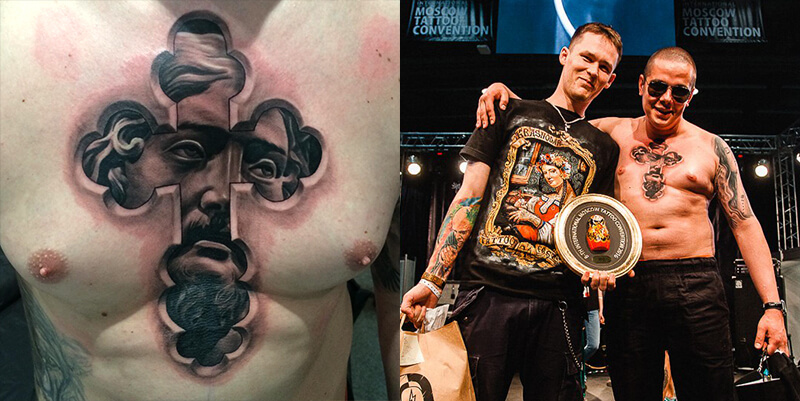
As an artist, you would love to come up with a completely new tattoo design every time. But clients keep bringing the same themes, lions, Jesus, popular characters, superheroes. It is easy to understand them, these images are loaded with meaning, they are recognizable, they sell well, and people are genuinely happy with those tattoos.
Even when you do yet another Jesus piece, you still try to change something, the angle, the composition, the details, the lighting, the shape of the beard. At some point, constant uniqueness slowly turns into a routine, and that is a normal part of life for a working tattoo artist. At the same time, tattoo culture has always had its “main characters,” for one person it is Jesus, for another Spider Man, for a third Iron Man or a favorite musician. Realism simply gives a way to bring these characters onto the skin in the most recognizable form.
Rinat: There is a constant tension between wanting to create unique work and working with real demand.
As an artist, you would love to come up with a completely new tattoo design every time. But clients keep bringing the same themes, lions, Jesus, popular characters, superheroes. It is easy to understand them, these images are loaded with meaning, they are recognizable, they sell well, and people are genuinely happy with those tattoos.
Even when you do yet another Jesus piece, you still try to change something, the angle, the composition, the details, the lighting, the shape of the beard. At some point, constant uniqueness slowly turns into a routine, and that is a normal part of life for a working tattoo artist. At the same time, tattoo culture has always had its “main characters,” for one person it is Jesus, for another Spider Man, for a third Iron Man or a favorite musician. Realism simply gives a way to bring these characters onto the skin in the most recognizable form.
Stories About Matching Tattoos
Journalist: Have you ever met people with tattoos like yours?
Rinat: Yes, and it is always an interesting experience.
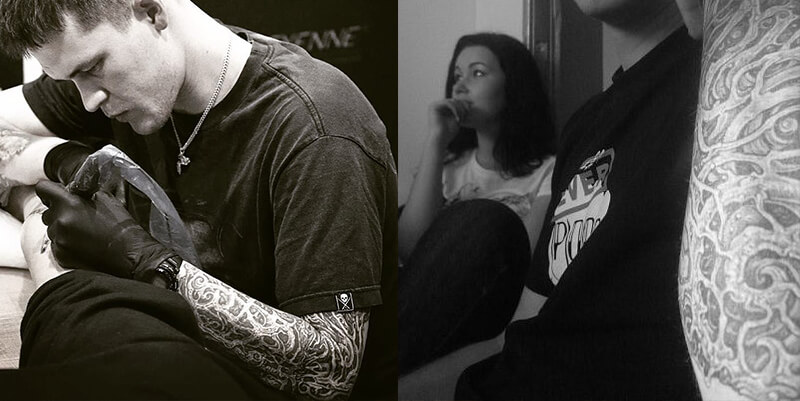
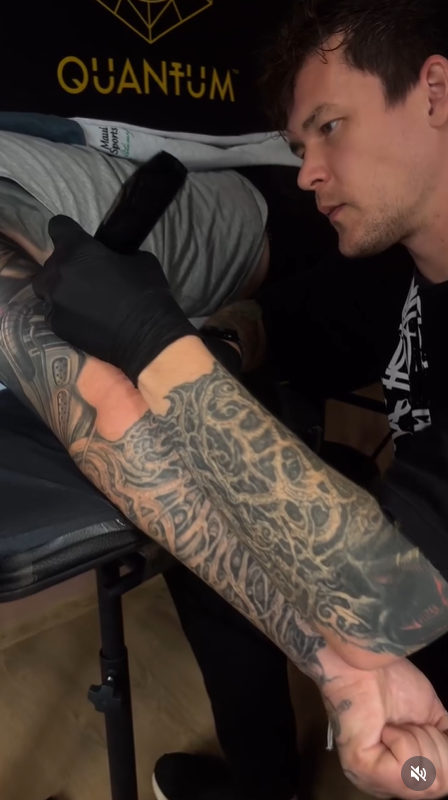
One time I was sitting in a bar and noticed a guy with a tattoo in the same freehand style as mine. We figured out that both of us had gone to the same artist, someone who draws signature organic shapes directly on the skin without a stencil. The composition and the nature of the lines were so recognizable that the tattoos looked very similar. We started talking, became friends, and still keep in touch. It did not feel awkward, more like we had been connected by the same creative source.
Another time I came across a girl on social media who had the same upper back tattoo as I do, based on the same painting by an artist whose name I unfortunately do not remember. We chatted, laughed, and there was zero negativity about “having the same tattoo.” Sometimes it is just a cool coincidence.
In a world with millions of people and thousands of tattoo designs constantly moving between studios and continents, repeats are inevitable. If everyone around you had exactly the same tattoo, that would look strange. But when two people accidentally discover related pieces, it often feels like a small sign of shared taste, a point of connection.
Rinat: Yes, and it is always an interesting experience.
One time I was sitting in a bar and noticed a guy with a tattoo in the same freehand style as mine. We figured out that both of us had gone to the same artist, someone who draws signature organic shapes directly on the skin without a stencil. The composition and the nature of the lines were so recognizable that the tattoos looked very similar. We started talking, became friends, and still keep in touch. It did not feel awkward, more like we had been connected by the same creative source.
Another time I came across a girl on social media who had the same upper back tattoo as I do, based on the same painting by an artist whose name I unfortunately do not remember. We chatted, laughed, and there was zero negativity about “having the same tattoo.” Sometimes it is just a cool coincidence.
In a world with millions of people and thousands of tattoo designs constantly moving between studios and continents, repeats are inevitable. If everyone around you had exactly the same tattoo, that would look strange. But when two people accidentally discover related pieces, it often feels like a small sign of shared taste, a point of connection.
Tattoos as a Way to Find Your People
Journalist: So matching tattoos can actually help people find each other?
Rinat: Absolutely.
Think about band tattoos. You are walking down the street, you spot the logo of your favorite metal band on someone’s arm, and you instantly feel respect for that person. You nod, maybe exchange a couple of words, and you already have something in common. Tattoos act like visual beacons, they can signal your interests, values, and sense of humor before you ever start talking.
Not every tattoo carries positive meaning, but the principle is the same. Realistic tattoos, lettering, symbols, all of that helps people find their own in this huge world. Sometimes you walk out of a tattoo shop not only with a new piece on your skin, but also with a new way to show the world who you are.
Rinat: Absolutely.
Think about band tattoos. You are walking down the street, you spot the logo of your favorite metal band on someone’s arm, and you instantly feel respect for that person. You nod, maybe exchange a couple of words, and you already have something in common. Tattoos act like visual beacons, they can signal your interests, values, and sense of humor before you ever start talking.
Not every tattoo carries positive meaning, but the principle is the same. Realistic tattoos, lettering, symbols, all of that helps people find their own in this huge world. Sometimes you walk out of a tattoo shop not only with a new piece on your skin, but also with a new way to show the world who you are.
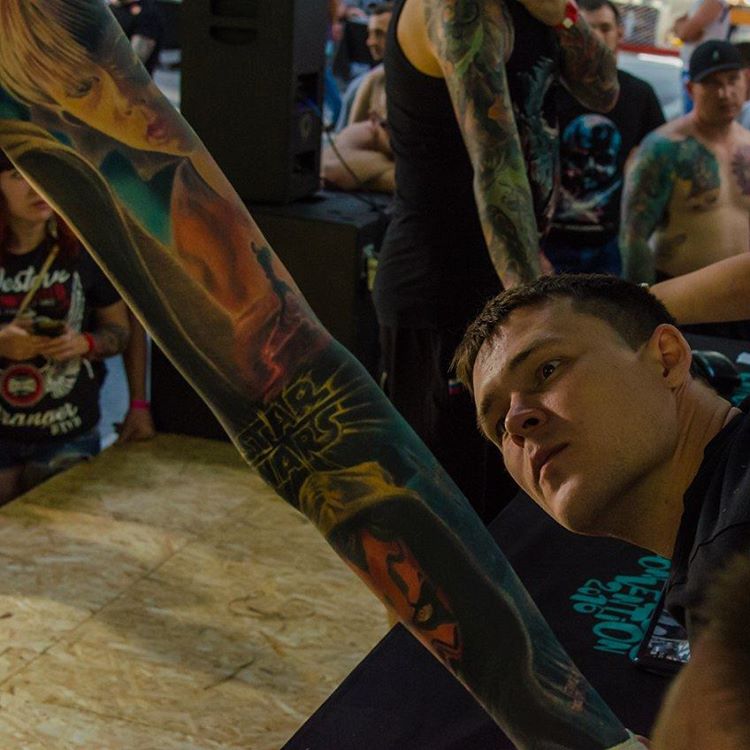
In the next article, we will continue this conversation and move into Japanese tattooing and irezumi. We will talk about full backs, body suits, traditional motifs, and how this aesthetic fits into modern life.
Check out this gallery of realistic portraits by Rinat Mingazdinov.