
Your first tattoo can become something bigger than just a drawing on skin. It can transform into a work of art that receives recognition from the professional community. My clients' work regularly takes home awards at tattoo conventions—from Los Angeles and San Diego to Dallas, Charlotte, and across America. This isn't luck. It's the result of the right approach to planning, choosing an artist, style, and execution.
I've been working since 2002. In that time, hundreds of clients have passed through my hands, many starting from scratch. Some just wanted beautiful work for themselves. Others set their sights higher: create something so outstanding that tattoo convention judges would appreciate it. And they achieved their goal.
Today I'll explain how to walk this path step by step. From the first thought about a tattoo to the moment when your work receives a nomination or prize at a convention. This isn't a quick process, but if you're ready to invest time, money, and patience, the result will exceed expectations.
Step 1: Define Your Idea and Scale
The first tattoo often comes from emotion. The desire to capture something, immortalize an important moment, express yourself. But if you want not just a personal memory but a work of art that will be professionally evaluated, you need to think bigger.
Small tattoo vs. large-scale work. Conventions typically award large detailed pieces. A small inscription on the wrist or symbol behind the ear won't win Best of Show. If recognition is the goal, go for scale: sleeve, thigh, back, chest, full leg.
Style matters. Realism, biomechanical, Japanese, neo traditional, blackwork—these styles win conventions more often because they demonstrate technical mastery, composition, and detail. Minimalism and fine line look stylish on Instagram, but convention judges evaluate ink density, line clarity, and execution complexity.
Subject and emotion. Portraits, memorial tattoos, mythological creatures, animals with character, complex compositions with multiple planes—all attract judges' attention. The stronger the emotional weight and visual power, the higher the chances.
Ask yourself:
- What do I want to say with this tattoo?
- Am I ready to invest in a large piece (minimum one full-day session)?
- What style will convey my idea most powerfully?
Step 2: Choose an Artist with Convention-Winning Experience
Not every artist can create convention-level work. This is a separate league. Convention judges are experienced tattoo artists who see the technical side of work that an average client might not notice.
What to look for:
Healed work portfolio. A fresh tattoo always looks bright. But how does it look after 6 months, a year, three years? Convention-level artists show healed work because that's where real technique shows: ink density, line clarity, no fading.
Convention awards. If an artist regularly takes home awards at tattoo conventions (Los Angeles, San Diego, Dallas, Charlotte, Miami, New York), that's confirmation of professional level. I've won first, second, and third places at conventions across America. This isn't bragging, it's an indicator that work has been valued by colleagues and judges.
Specialization in your style. If you want a realistic portrait, look for an artist who specializes in realism. If biomechanics—an artist who works freehand and understands anatomy.
Willingness to work on large projects. Big pieces require multiple full-day sessions. Make sure the artist is ready to take on a large-scale project and see it through.
Honesty and realistic expectations. A good artist will honestly say how long the work will take, what difficulties might arise, what's realistic to do in one session versus what will require several. If an artist promises to do a full convention-level sleeve in one day—that's a red flag.
Step 3: Consultation and Project Planning
Convention-level tattoos aren't done spontaneously. It's always planning.
What to discuss during consultation:
Concept and subject. What do you want to see? What elements matter? Do you have references (photos, paintings, illustrations)? The artist should understand your idea and suggest how to adapt it for a tattoo.
Size and placement. Where will the work be? What size is needed for details? For a portrait, minimum 4 × 6 inches, otherwise facial features will blur. For biomechanics—minimum half forearm or shoulder, otherwise composition loses depth.
Style and technique. Discuss which style will best convey the idea. Realism, neo traditional, Japanese, biomechanics—each style has its strengths. The artist should explain why they're suggesting a specific approach.
Session count and timing. How long will the work take? How many sessions are needed? What breaks between sessions? Usually 4–8 weeks are needed between full-day sessions for healing. If you're planning to participate in a convention, factor in deadlines: work must be completed and fully healed at least a month before the event.
Price and mutual understanding. Convention-level work requires high skill, time, and attention to detail. But when artist and client share a common goal—creating something outstanding—you can always find a compromise that works for both sides. It's win-win: the client gets a work of art, the artist adds a convention-level piece to their portfolio. Discuss openly, be ready to invest, and the artist will appreciate your seriousness.
Agreement about convention participation. If you want to participate in a tattoo convention, discuss this with the artist ahead of time. Work is submitted to the convention in the artist's name, and you'll travel together to the event. On convention day, you're both present, judges evaluate the work, and if you win—you go on stage together for the award. It's a joint success, a team effort. In very rare cases, work can participate without the client present, but usually the tattoo bearer must be there.
Step 4: Work Process—Patience and Trust
Large pieces can be completed in one full-day session if it's a medium composition, or require multiple sessions for large-scale projects. Be ready for an intensive process.
Full-day session. Usually lasts 6–8 hours with breaks every 1.5–2 hours. This is an intensive process. Skin gets tired, the body accumulates stress. But these sessions allow achieving high detail and ink density.
Between sessions: healing. After each session, skin needs 4–8 weeks to fully heal. Don't rush. If you start the next session too soon, skin won't accept pigment properly and the work will lose density.
Pain and endurance. Some zones are painful (ribs, sternum, inner bicep, elbow, knee, spine). Others are tolerable (shoulder, forearm, thigh, upper back). If you're a beginner, start with a less painful zone. Numbing creams can be used, but discuss this with the artist ahead—they can affect pigmentation quality.
Trust the artist. If you've chosen a convention-level artist, trust their decisions. They know what details to add, where to strengthen contrast, how to build composition. Don't try to control every step—give the artist space for creativity.
Step 5: Preparing for a Tattoo Convention
If your goal is recognition at a convention, here's what you need to know.
What is a tattoo convention. An event where tattoo artists from across the country (and world) gather to work, exchange experience, and participate in competitions. Clients with outstanding tattoos come with their artists to compete.
Award categories. Usually there are categories: Best Black and Gray, Best Color, Best Portrait, Best Sleeve, Best Back Piece, Best Large Tattoo, Best of Show. There may also be specialized categories: Best Biomechanical, Best Japanese, Best Realism.
Where conventions happen. In California, conventions regularly occur in Los Angeles (Los Angeles Tattoo Convention), San Diego (San Diego Tattoo Convention), San Francisco. But you can participate across America: Dallas (Dallas Tattoo Convention), Miami (Miami Ink Convention), New York (New York Tattoo Convention), Chicago, Las Vegas, Atlanta, Phoenix. If you set a goal, you can travel with your artist across the country and collect awards in different cities.
How to submit work for competition. Usually registration happens on-site on convention day. The artist registers the work in a specific category, you're present alongside, judges evaluate. Some conventions require advance online registration. Work is submitted in the artist's name, but you—the tattoo bearer—are a required part of the process.
What judges evaluate:
- Technical execution: line clarity, ink density, fill evenness, no gaps.
- Composition: element balance, space use, planes (foreground, middle, background).
- Detail: how well small elements, textures, shadows are worked.
- Originality: idea uniqueness, creative approach.
- Emotional impact: how much the work grabs attention, evokes response.
- Healing condition: work must be fully healed, no scabs, inflammation, signs of recent session.
Competition preparation:
- Make sure the work is fully healed (minimum 4–6 weeks after last session).
- Moisturize skin before the convention so the work looks bright and saturated.
- Come in comfortable clothing that allows easy display of the tattoo.
- Be ready for judges to ask questions about the work, how long it took, who the artist is.
Step 6: Convention Participation and Results
Convention day is the culmination of the entire journey. You arrive with your artist at a hall where hundreds of artists work, thousands of people walk around, look, discuss. The atmosphere is charged.
Registration. The artist registers your work in a specific category. You're present alongside because judges need to see the work on the body. It's a team effort.
Judge evaluation. Judges approach, carefully study the work, take notes. Sometimes they ask questions. The process can take several hours because judges evaluate dozens of pieces.
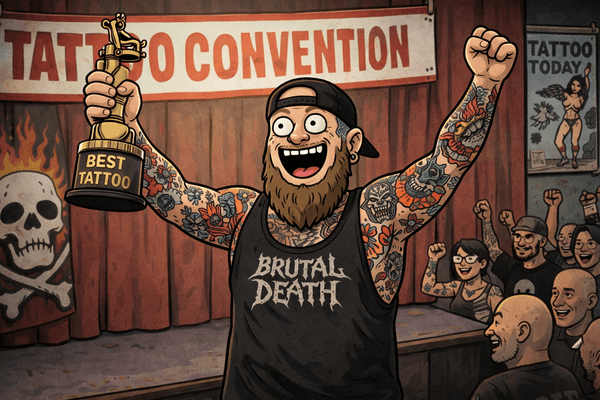
Results announcement. Usually at the end of the day or the next day, winners are announced in each category. If your work takes first, second, or third place, you and the artist go on stage together, receive a trophy or certificate, take photos. It's a moment of pride for both—a shared victory.
If you don't win. Not every piece takes an award, even if technically flawless. Competition is high, judge subjectivity plays a role. But participation itself is an achievement. You gain experience, see the level of other work, understand where to grow. If you don't win at the first convention, you can participate at the next one, in another city, in another category.
If you win. This confirms that you and your artist created something outstanding. The work receives recognition from the professional community. The artist adds the award to their portfolio, you can proudly say you have an award-winning tattoo. This opens doors: some clients specifically seek artists whose work has won at conventions.
Real Examples: Convention-Winning Work
I've worked with clients whose tattoos received awards at conventions across America. Here's what united them:
Scale. None of the awarded pieces were small. Minimum—half sleeve. More often—full sleeve, back, leg.
Detail. Each piece had multiple planes, complex composition, small details that became visible on close inspection.
Emotional depth. Memorial portraits (mother, father, child), biomechanics integrated with client anatomy, Japanese scenes with deep symbolism—all work told a story.
Client readiness. Some pieces were completed in one full-day session, others required multiple full-day sessions. Clients were ready to invest time and patience.
Collaborative work. Client trusted artist, artist listened to client. It's always collaboration, not dictation from one side.
Final Tips: Path from Idea to Award
- Define a large-scale idea. Small pieces don't win conventions. Go for sleeve, back, leg, chest.
- Choose an artist with winning experience. Not every artist can create convention work. Look for one who regularly takes home awards.
- Plan the project ahead. Discuss concept, style, session count, timeline. If you want to compete, tell the artist immediately. Find a price compromise that works for both—it's win-win.
- Be ready for a long process. Large pieces require minimum one full-day session, sometimes several, and months of healing between sessions. Don't rush.
- Participate in conventions with your artist. Los Angeles, San Diego, Dallas, Miami, New York—conventions happen nationwide. Set a goal, come with your artist, go on stage together for the award.
- Celebrate the result. If the work receives recognition, it's a shared victory—yours and the artist's. It's a moment of pride that will last a lifetime.
Inkology Tattoo Art Gallery
303 S Crescent Heights Blvd, West Hollywood, Los Angeles
Phone: +1 323 351 9888
Consultation is free if you book work afterward. If your goal is to create a convention-level tattoo, come in and we'll discuss how to bring your idea to life.
Since 2008, I have participated in leading tattoo conventions - from Villain Arts in Chicago and Hell City in Phoenix to festivals in Nice, Rome, and Zurich. More than 30 awards in categories ranging from large-scale Japanese style to realistic black and gray.