
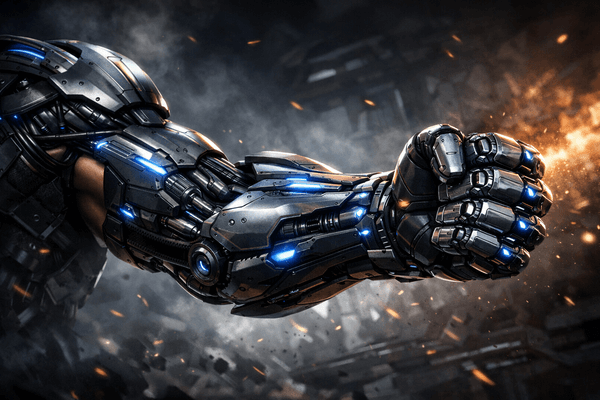
Biomechanical tattoos only work at large scale. A small fragment on the wrist or behind the ear looks like a random smudge. This style needs space to show depth, layers, and transitions between organic flesh and mechanical elements.
I work in multiple styles, but biomechanics holds a special place for me. It is the only style where I offer serious discounts on large projects. Not because I want to earn faster, but because I genuinely love creating these pieces and want to see more truly epic biomechanical work in my portfolio.
Why large scale matters
Think of biomechanics as revealing the internal architecture of the body. Imagine your skin becomes transparent and underneath you see not bones and muscles but a complex mechanism: tubes, circuit boards, generators, gears, wires, glowing elements. To make this illusion convincing, you need surface area.
Small patches cannot convey multilayered depth. You get a flat drawing, not the effect of an embedded mechanism. The larger the canvas, the more detail you can pack in, the more realistic the cyborg illusion becomes.
Minimum format for biomechanics: roughly half a forearm or half an upper arm. This allows at least one large central element (a generator, joint, panel with circuit boards) surrounded by background details.
Optimal format: full sleeve wrist to shoulder, leg from ankle to knee or higher, back, chest flowing into shoulder. Here you can unfold a complete composition with multiple depth levels and different types of mechanical elements.
Maximum format: a bodysuit spanning multiple zones. Arm plus chest and part of back. Both legs transitioning to hips. Back flowing into arms and legs. These projects take years but deliver the most powerful visual impact.
Placement ideas focused on visual drama
Do not just think about where to place the tattoo. Think about what kind of effect you want to create.
Arm strategies
Half sleeve (elbow to shoulder or wrist to elbow): A convenient starting point. You can do one session, see the result, decide whether to continue. But visually, half sleeves always look unfinished. The mechanism appears cut off mid-journey.
Full sleeve (wrist to shoulder): The biomechanical classic. The entire arm transforms into a mechanical limb. The composition closes, details flow seamlessly, the arm reads as a unified device. Three to four full day sessions with healing intervals.
Arm plus chest and shoulder: Even more dramatic. The mechanism does not stop at the shoulder but continues across the chest, creating the impression that implants are hidden under the skin of your entire torso. Five to six sessions, but the visual punch is massive.
Leg approaches
Knee down (shin and foot): Comfortable zone, relatively tolerable pain, lots of flat surfaces. Two to three sessions. Downside is that legs are covered most of the year unless you live in shorts year round.
Knee up (thigh): The largest and most convenient canvas on the body. Nearly painless, huge space for detail. Two to three sessions for a full thigh. The tattoo is only visible at the beach or at home, but for people who tattoo for themselves rather than display, this is ideal.
Full leg (ankle to hip): The entire leg becomes a mechanical limb. Five to seven sessions. The knee is painful but the result is worth it.
Back options
The back offers maximum real estate. You can build a symmetrical composition with a central element (for example, the spine transforms into a mechanical spine column) or asymmetrical (the mechanism overtakes one side of the back and flows into an arm or ribs).
The back is painful near the spine and lower back, but the upper portion and shoulder blades are tolerable. Full back requires five to eight sessions.
Chest and ribs
The chest is visually powerful, especially on men. A chest tattoo is visible in the mirror every day, creating the sensation of a built in generator heart or armored plating. Ribs are one of the most painful zones, but in biomechanics they are often used to transition from chest to back or arm.
Full chest takes three to four sessions. Chest plus ribs and transition to arm takes six or more.
Color vs black and grey
Biomechanics works in both approaches.
Black and grey biomechanics looks like metal, carbon fiber, dark composite plates. High contrast, sharp, ages well. Perfect for those who want a cold industrial look. Details remain readable for decades because black pigment holds best.
Color biomechanics adds energy. Red glowing elements, blue backlighting, yellow or orange details mimicking burning generators or heated parts. Color makes the work more alive, especially if you want cyberpunk aesthetics with neon accents.
Color requires slightly more time per session and more careful maintenance after healing. In sunny Los Angeles, color tattoos fade faster without constant sunscreen use. But with proper care, color biomechanics looks fantastic.
I usually recommend combining. Black and grey foundation with color accents. This gives the best balance between longevity and visual effect.
Pain and session length realities
Large biomechanics is done in full day sessions. This is the only way to maintain unity of composition, tone, and style. If you split the work into short two to three hour sessions, transitions between sections will be uneven and the overall picture will fall apart.
A full day session is six to eight hours with breaks. The first two hours are tolerable. By the third hour the skin starts to tire. By the fifth hour even calm zones begin to hurt more. This is normal.
Most tolerable zones for long sessions: shoulder, upper back, thigh, outer forearm. Here you can work six to eight hours with minimal breaks.
Medium pain: inner forearm, shin, chest (away from sternum).
Most painful: ribs, sternum, inner bicep, elbow, knee, wrist, foot, spine. On ribs even experienced clients ask for a break every hour to hour and a half.
Endurance tips:
- Sleep well the night before.
- Eat a solid meal an hour before the session. Low blood sugar amplifies pain.
- Bring sweets (candy, chocolate) and water.
- Breathe slowly and deeply, especially when it hurts.
- Listen to music, podcasts, watch videos on your phone. Distraction genuinely helps.
- Do not hesitate to ask for a break. We take short stops every hour and a half to two hours plus one long lunch break.
Never show up to a session hungover, exhausted, or sick. This multiplies pain several times and affects healing quality.
Consultation and design process
Every large biomechanical tattoo starts with a consultation. This is a meeting where we discuss your vision, choose placement, estimate time and cost, and confirm expectations.
I do consultations in person at Inkology Tattoo (303 S Crescent Heights Blvd, West Hollywood) or via video call for clients coming from Beverly Hills, Santa Monica, or farther out. Consultations are free if you plan to proceed with the project.
What we cover:
- References and ideas. Show me examples of what you like: style of mechanical elements (modern circuit boards and glowing details or more classic gears and tubes), color palette (black and grey, color, or combined), overall atmosphere (cold metal, burning cyberpunk, organic transitions).
- Placement and size. We discuss anatomy, how the design will flow with your body, whether the chosen spot has enough space.
- Project scale. Half sleeve, full sleeve, leg, back, chest, or full bodysuit across multiple zones. The larger the scale, the more detail and impact.
- Session count and schedule. How many full day sessions are needed, what intervals between them, deposits.
- Cost. Transparent, no surprises. And here is the important part: biomechanics is special to me. If you are ready to commit to a large project (full sleeve, full leg, back, or bigger), I am ready to offer a discount. The larger the scale, the better the terms.
I usually provide a sketch or digital mockup one to two days before the first session. This gives you time to request adjustments. Once we start, changes are harder.
Los Angeles pricing and special terms for biomechanics
Biomechanical tattoos are priced by time, not by design complexity or size alone. The Los Angeles market varies widely depending on artist experience, location, and demand.
General market rates:
- Hourly: $200 to $400 per hour.
- Full day session (6 to 8 hours): $1,600 to $3,200. My standard rate is $1,700 per day.
But for biomechanics I make an exception.
Biomechanics is a style I genuinely love and want to develop. I want to see more truly massive biomechanical pieces in my portfolio. So if you are ready to commit to a large project, I am open to discussing serious discounts.
What counts as a large project:
- Full sleeve (wrist to shoulder) – three to four sessions.
- Full leg – four to six sessions.
- Back – five to eight sessions.
- Chest plus arm – five to seven sessions.
- Bodysuit covering multiple zones (for example, both arms plus chest and back) – ten or more sessions.
The bigger you are willing to go, the better the terms. If you are open to my ideas, willing to trust my vision of the composition, and do not resist suggestions to expand the project, we can discuss even more flexible pricing.
For example, you come in with an idea for a half sleeve on the forearm. I see that the anatomy of your arm allows continuing the composition onto the shoulder and part of the chest, and this would look significantly more impressive. If you agree to expand the project, we can negotiate a better price for the entire volume of work.
Estimated project costs:
- Half sleeve (biomechanics): $1,700 to $3,400 (one to two sessions).
- Full sleeve: $5,100 to $6,800 (three to four sessions, but with discount can be less).
- Full leg: $6,800 to $10,200 (four to six sessions, with discount more favorable).
- Full back: $8,500 to $13,600 (five to eight sessions, with discount significantly cheaper).
Higher prices usually reflect higher skill, better equipment, cleaner studios, and longer wait lists. Lower prices can mean less experience, rushed work, or compromised hygiene. Not always, but often. Do your research.
Why people choose me for biomechanics
I work in several styles (realism, Japanese, neo traditional), but biomechanics holds a special place. This is the style that lets me experiment, blend organic and technology, create visual illusions of embedded mechanisms.
What I offer:
- Experience with large scale projects. I have done full sleeves, legs, backs, bodysuits. I understand how to build compositions across large areas, how to maintain style unity across multiple sessions.
- Working with anatomy. Biomechanics must emphasize body form, not fight it. I use freehand (drawing directly on skin) to adapt the design to your muscles, curves, movements.
- Modern aesthetics. I am not stuck on old gears and torn skin. My biomechanical work includes modern elements: circuit boards, microchips, glowing LEDs, generators, cables, panels. Cyberpunk, not steampunk.
- Color mastery. I can work in black and grey, full color, or combination. I add color strategically to enhance the effect, not overload the composition.
- Pricing flexibility. If you are ready to commit to a large scale project, I am ready to offer favorable terms. This is win win: you get an epic tattoo at a fair price, I get the opportunity to realize an ambitious design.
Biomechanics for cover ups
Biomechanics works exceptionally well for covering old poor quality tattoos, especially large ones. Because the style adapts to muscle shape and body volume, you can play with dark and light areas, shift accents, change detail shapes and element depth.
In biomechanics you can freely work with negative space, covering old designs with layers of mechanics, tubes, and plates, achieving spectacular overlays of old tattoos.
What covers well:
- Faded tattoos. Easy to cover with darker biomechanical shading.
- Medium old pieces. Can be incorporated into a larger biomechanical composition (for example, turning an old tribal band into part of a sleeve background).
- Strategic design. Using dark areas of the new piece (shadows, hair, background) to mask old ink.
What is challenging:
- Dense black work. Solid black areas are nearly impossible to cover without laser pre treatment.
- Large old tattoos in prime placement. Limits design options.
If you are considering a cover up, bring photos of the existing tattoo to the consultation. I will assess whether biomechanics can work or if laser lightening is needed first.
Bottom line
Biomechanical tattoos are high skill, high investment projects. They demand large scale, careful planning, experienced artists, and patient commitment.
For clients in Los Angeles who want to transform their body into a cyberpunk work of art, full day sessions with an experienced biomechanics specialist deliver lasting results.
If you are ready for a large scale project, for several months or years of gradually building a mechanical bodysuit on your body, come in for a consultation. We will discuss your vision, assess possibilities, and agree on favorable terms.
Visit Inkology Tattoo Art Gallery at 303 S Crescent Heights Blvd in West Hollywood. Call or message us at +1 323 351 9888 to book your consultation.
Guide to Biomechanics 2026: how to turn your body into a cyborg, modern cyber-mechs, and the cost of tattoo sleeves
Check out my portfolio of biomechanical tattoos